


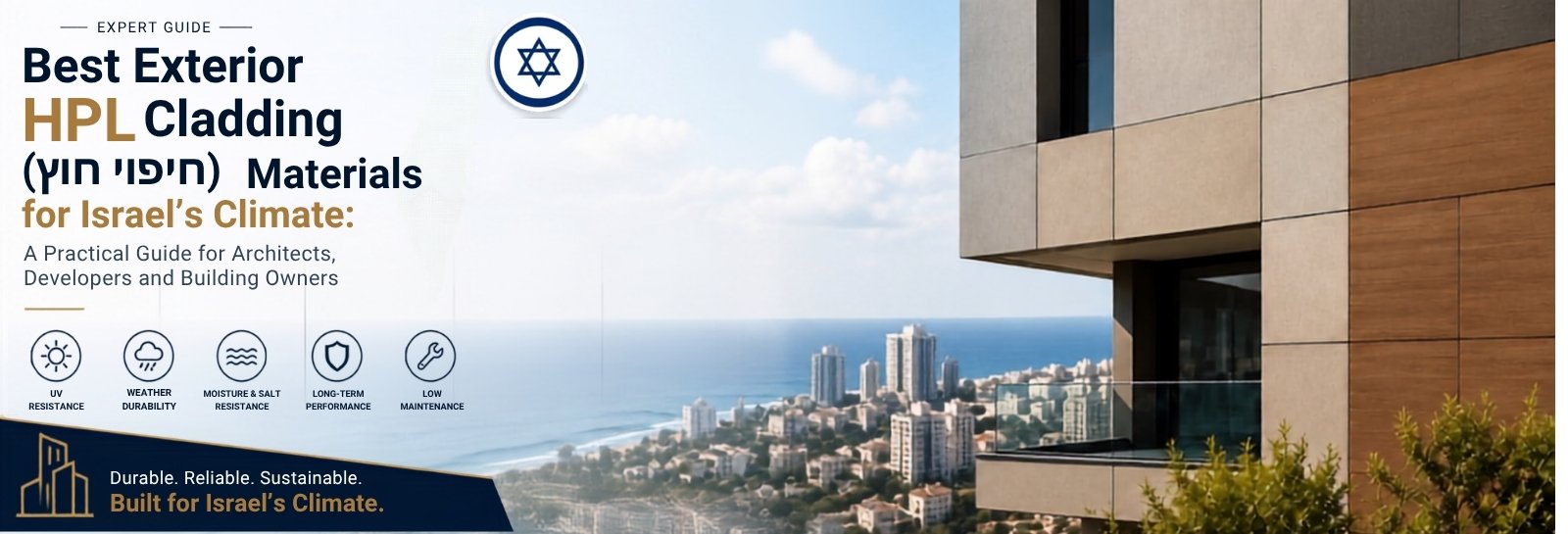
Best Exterior Cladding (חיפוי חוץ) Materials for Israel’s Climate: A Practical Guide for Architects, Developers and Building Owners
The exterior façade of any building is one of its most visible and technically important elements. Beyond aesthetics, the façade protects the structure from weather, supports long-term building performance, and adds value to the property.
In Israel, exterior façade materials face demanding environmental conditions. Along the Mediterranean coastline, buildings are exposed to humidity, salt-laden air, and moisture. In many inland areas, façades must withstand prolonged sun exposure, high UV levels, seasonal temperature fluctuations, and daily thermal movement.
For these reasons, Exterior Cladding (חיפוי חוץ) materials used in Israel must offer durability, dimensional stability, colour stability, and low maintenance over many years. Choosing the right cladding system is therefore not only a design decision, but also an investment in long-term building performance.
High-Pressure Laminate, commonly known as HPL, is one of the most reliable and widely used façade materials for modern buildings. When manufactured specifically for exterior use and tested in accordance with recognised standards such as EN 438, exterior compact HPL can deliver excellent performance for commercial, institutional, residential, hospitality, and public infrastructure projects.
Understanding Israel’s Climate Before Selecting Exterior Cladding (חיפוי חוץ)
Before selecting an exterior façade material, it is important to understand the local climatic conditions.
In Israel, architects and developers must consider several environmental factors:
- High solar radiation throughout the year
- Strong and continuous UV exposure
- Humid and salt-laden air in coastal cities
- Seasonal rainfall
- Daily and seasonal temperature variations
- Dust, wind, and general urban pollution
These conditions can affect the long-term appearance and performance of exterior materials. Materials that are not designed for harsh outdoor use may fade, warp, delaminate, crack, corrode, or require frequent maintenance.
Therefore, façade specification should be based on technical performance, tested standards, and long-term field experience — not only on colour, texture, or initial cost.
What Criteria Should Be Used to Select Exterior Cladding (חיפוי חוץ) Materials?
When selecting a façade material, architects and project owners should look beyond visual appeal. The following factors are especially important for Israel’s climate.
Weather Resistance
Exterior panels must remain stable and structurally sound when exposed to sun, rain, humidity, wind, and temperature changes. A good façade material should retain both its technical performance and visual appearance over many years.
UV Stability
UV exposure is one of the most important factors in Israel. Many façade materials may change colour or lose surface quality when exposed to continuous sunlight. Exterior-grade HPL should use high-quality decorative papers, UV-resistant surfaces, and tested weathering performance to reduce colour change and surface degradation.
Moisture Resistance
In coastal areas such as Tel Aviv, Haifa, Ashdod, Netanya, and other Mediterranean locations, moisture and salt-laden air can affect exterior materials. Dense compact laminate construction, when used with a properly designed ventilated façade system, can help manage moisture and improve long-term façade performance.
Mechanical Strength
Exterior panels must resist wind loads, impact, installation stresses, and normal building movement. Exterior-grade compact HPL has strong mechanical properties and is suitable for use in ventilated façade systems when installed in accordance with proper technical guidelines.
Low Maintenance
Maintenance costs are an important part of the life cycle cost of any building. Materials requiring frequent painting, polishing, repair, or replacement can become expensive over time. Exterior HPL offers a finished surface and normally does not require painting under regular use.
Popular Exterior Cladding (חיפוי חוץ) Materials
Different façade materials are used depending on the project type, budget, design intent, technical requirements, and local climate.
| Material | Strengths | Considerations |
|---|---|---|
| Exterior HPL | UV resistance, weather durability, design flexibility, low maintenance | Requires correct installation system |
| ACP (Aluminium Composite Panel) | Lightweight and versatile | Performance depends on specification and application |
| Natural Stone | Premium appearance and long life | Heavy, higher structural and installation cost |
| Fibre Cement | Good durability and fire performance | Maintenance varies by product |
| Ceramic Panels | Elegant finish and long service life | Higher installation complexity and cost |
Each material has its own strengths. However, for projects requiring design flexibility, long-term outdoor performance, and low maintenance, exterior compact HPL is becoming an increasingly preferred choice.
What Makes Exterior HPL Different?
High-Pressure Laminate (HPL) (למינוקת בלחץ גבוה) is produced by pressing layers of kraft paper impregnated with thermosetting resins under high pressure and high temperature. Exterior compact HPL is manufactured specifically for façade use, with a durable surface layer designed to withstand outdoor exposure.
The manufacturing process creates a dense, strong, and durable panel suitable for various exterior applications.
Key characteristics of exterior HPL include:
- High surface durability
- Good impact resistance
- Moisture resistance
- Colour stability
- Wide design flexibility
- Compatibility with ventilated façade systems
- Low maintenance requirements
Exterior HPL is especially suitable for modern architectural projects because it offers architects a wide choice of finishes, including woodgrains, solid colours, stone effects, and contemporary surfaces.
Why Exterior High-Pressure Laminate (HPL) (למינוקת בלחץ גבוה) Is Growing in Modern Architecture
Modern buildings require more than attractive façades. Architects and developers increasingly look for materials that provide:
- Long-term visual consistency
- Reliable technical documentation
- Certified manufacturing processes
- Sustainable material options
- Efficient installation systems
- Proven performance in real projects
Exterior HPL fulfils many of these needs. It allows architects to create modern, clean, and durable façades while giving developers confidence in long-term building performance.
Sustainability and Documentation
Sustainability is now an important consideration in many commercial, institutional, and public projects. Project teams may ask for technical and environmental documents such as:
- Environmental Product Declarations
- FSC-related documentation
- ISO management system certifications
- CE marking where applicable
- Product lifecycle information
- Fire, UV, weathering, and mechanical test reports
Many international manufacturers, including Samrat HPL, provide technical documentation and certifications to support architects, consultants, contractors, and project owners during the specification process.
Why EN 438 Matters
EN 438 is one of the most important European standards for High-Pressure Laminate (HPL)
(למינוקת בלחץ גבוה). It covers performance requirements and test methods for HPL products, including exterior-grade compact laminate.
For exterior HPL, EN 438 is important because it provides a technical basis for evaluating properties such as:
- Weather resistance
- Dimensional stability
- Impact resistance
- Surface durability
- Moisture behaviour
- Colour stability
When comparing exterior HPL products, architects should check whether the material is manufactured and tested according to EN 438 requirements for exterior use. This helps ensure that material selection is based on measurable performance, not only on visual appearance.
Why Samrat HPL Is a Strong Option for Israel
Samrat HPL is one of the strong exterior HPL options for the Israel market because the company is fully focused on exterior façade applications.
Unlike companies that manufacture many different laminate categories, Samrat HPL has built its strength around exterior compact HPL. This 100 % EXTERIOR HPL-focused approach allows the company to concentrate its product development, testing, raw material selection, and technical know-how specifically on façade performance.
For Israel’s climate, this focus is important because exterior façades require long-term resistance to UV, humidity, temperature variation, and weather exposure.
Samrat HPL’s Experience in Israel
Samrat HPL has been used in façade projects in Israel for more than 10 years. Over this period, more than 200,000 m² of Samrat exterior HPL has already been installed in the Israeli market.
This local installation experience is an important advantage. It shows that Samrat HPL is not only a new product being introduced to the market, but a tested façade material with real project history in Israel’s climatic conditions.
For architects, developers, contractors, and building owners, this provides additional confidence while specifying the material for new projects.
Global Experience of Samrat HPL
Samrat HPL’s exterior façade products are backed by large-scale international experience.
Today, Samrat HPL has:
- More than 9 million m² of exterior HPL installed globally until 2025.
- More than 30,000 completed projects
- Presence in 25+ countries
- Over 10 years of façade installation experience in Israel
- More than 200,000 m² already installed in Israel in the past 10 years.
- A 100% exterior HPL-focused product approach
- International certificates and technical documents such as FSC, ISO, CE, EPD and other quality documentation as applicable
This combination of global experience and local project history makes Samrat HPL a practical and reliable option for Israel’s façade market.
The Samrat HPL Approach
Samrat HPL produces exterior compact HPL with a clear focus on long-term façade performance. The company’s approach is based on:
- Careful exterior-grade paper selection
- Preference for suitable pigment systems for outdoor exposure
- Focus on UV and weather resistance.
- Exterior compact laminate manufacturing experience
- Technical documentation for architects and consultants
- Long-term façade market experience
- Local distribution and project support in Israel
Products are distributed in Israel through an authorised local distribution partner, providing local availability, technical support, and project coordination for architects, developers, contractors, and building owners.
Frequently Asked Questions
Can HPL be used in Israel’s climate?
Yes. Exterior-grade compact HPL is designed for outdoor use and can perform well in Israel’s climate when it is manufactured for exterior applications, tested to recognised standards, and installed correctly.
Why is UV resistance important in Israel?
Israel has strong sunlight and high UV exposure for much of the year. UV resistance is important because it helps reduce colour fading, surface degradation, and long-term visual changes on the façade.
Why is inorganic paper selection important?
Inorganic pigment-based decorative papers generally offer better long-term UV and colour stability for exterior façade applications. This makes them especially important for countries with high sun exposure, such as Israel.
Does exterior HPL need painting?
No. Exterior HPL comes with a finished decorative surface and normally does not require painting under regular use.
Can HPL be used for commercial buildings?
Yes. Exterior HPL is commonly used in offices, schools, hospitals, hotels, residential buildings, retail projects, and public infrastructure.
Can HPL be used in ventilated façade systems?
Yes. Exterior compact HPL is widely used in rear-ventilated façade systems when designed and installed according to project-specific technical requirements.
Why should architects consider Samrat HPL for Israel?
Architects should consider Samrat HPL because it is a 100% exterior-focused HPL company with more than 10 years of installation experience in Israel, over 200,000 m² already installed in the country, and more than 9 million m² installed globally.
Conclusion
Selecting the right exterior cladding material is one of the most important decisions in a building project. A façade must not only enhance the appearance of the building, but also perform reliably in the environment where it is installed.
In Israel, buildings face strong sunlight, UV exposure, coastal humidity, seasonal rainfall, and temperature variations. Therefore, façade materials must be selected on the basis of technical performance, tested standards, and proven project experience.
Exterior HPL combines durability, design flexibility, low maintenance, and long-term façade performance. When manufactured according to recognised standards such as EN 438 Exterior Cladding (חיפוי חוץ) and supported by proper technical documentation, it gives architects, developers, contractors, and building owners confidence throughout the design and construction process.
Samrat HPL stands out as a strong option for the Israel market because of its 100% exterior-focused approach, careful raw material and paper selection, more than 10 years of façade installation experience in Israel, over 200,000 m² already installed in the country, and more than 9 million m² installed globally.
For commercial offices, education campuses, hospitals, hotels, residential developments, and public projects, choosing the right façade material today can positively affect building performance for many years. For Israel’s demanding climate, Samrat HPL offers a practical, proven, and technically reliable exterior cladding solution.
Connect with our authorised local partner in Israel to coordinate project samples and technical specifications.