


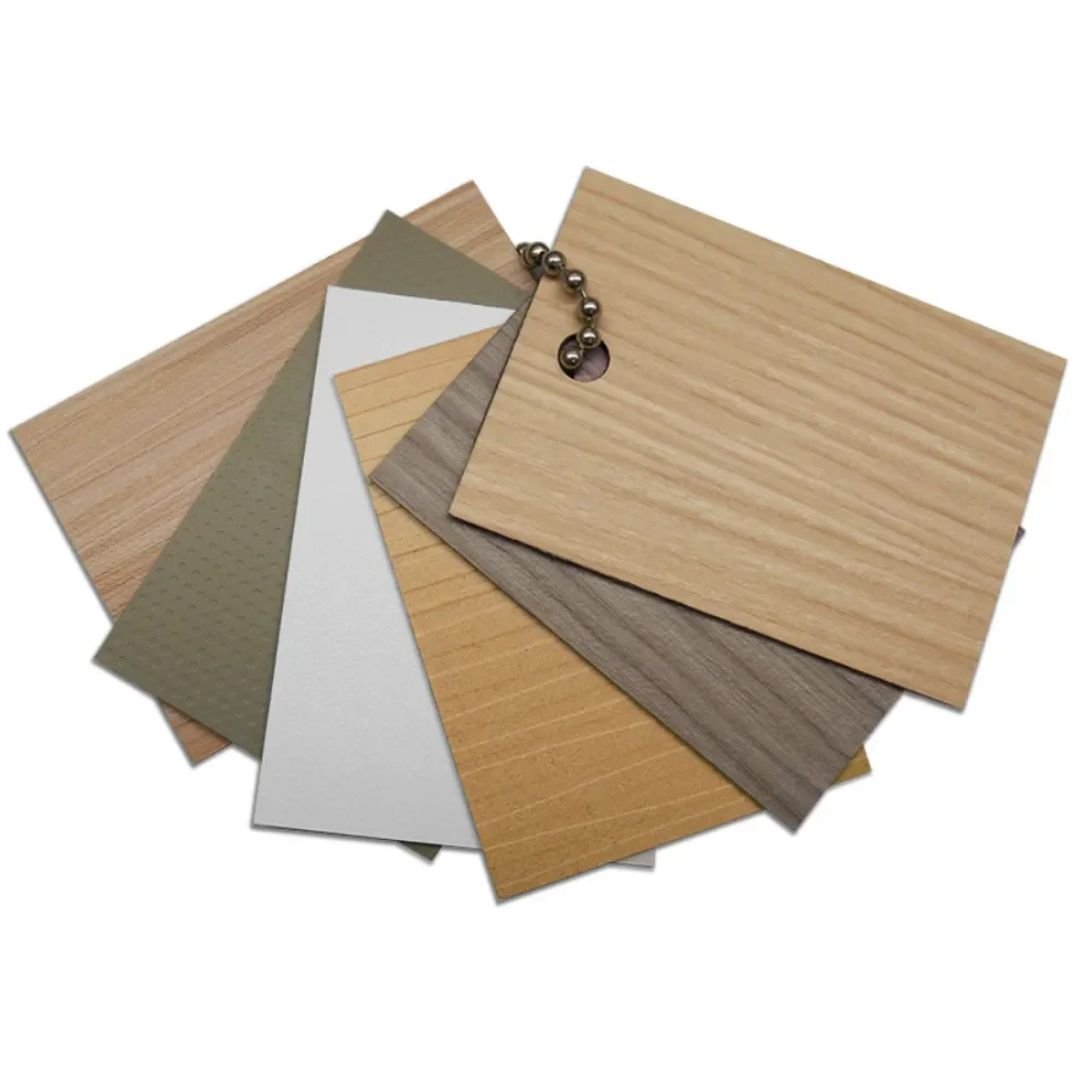
Different Buildings, Different Needs – Engineered by Samrat HPL
Although Exterior HPL Cladding is the same material at its core, its role and performance expectations change significantly when applied to residential buildings versus commercial projects.
At Samrat HPL, we manufacture and supply Exterior Compact HPL Cladding to a wide spectrum of projects across Europe and the Middle East—from private villas to large commercial, institutional, and public buildings.
With a landmark achievement of over 9 million square metres of Exterior HPL installed globally till 2025, Samrat HPL’s products are not just specified—they are proven in real-world façade applications across diverse climates and building typologies.
Understanding the Fundamental Difference
| Parameter | Residential Buildings | Commercial Buildings |
| Primary focus | Aesthetics & comfort | Performance & safety |
| Facade size | Smaller, segmented | Large, continuous |
| Traffic & impact | Low | High |
| Fire regulations | Moderate | Strict |
| Maintenance tolerance | Very low | Extremely low |
Exterior HPL is one of the few façade materials capable of meeting both sets of expectations reliably, which explains its growing adoption worldwide.
If you are new to the material, start with:
“What Is Exterior HPL Cladding? A Complete Beginner’s Guide”

Exterior HPL for Residential Buildings
Residential architecture prioritizes visual warmth, long-term appearance, and ease of ownership.
Typical Residential Applications
- Villas and independent houses
- Apartment façades
- Balconies and terraces
- Boundary walls and soffits
Why Samrat HPL Works for Residential Facades
- Wide range of solid colours and woodgrains
- Excellent UV resistance for long-term colour stability
- Very low water absorption
- No repainting or surface treatment required
Samrat HPL’s use of decorative papers from reputed EU printers, combined with a 50-micron Plexiglass (PMMA) UV protection film, ensures that residential facades maintain their original aesthetics for years—even under harsh sunlight.
Related reading:
“Why Exterior HPL Is Ideal for Modern Building Facades”
Exterior HPL for Commercial Buildings
Commercial buildings impose much higher technical and regulatory demands on façade materials.
Typical Commercial Applications
- Office buildings
- Hotels and hospitality projects
- Educational institutions
- Hospitals and healthcare facilities
- Retail and mixed-use developments
Key Commercial Requirements
- High wind-load resistance
- Fire-safe façade solutions
- Impact resistance in public areas
- Long-term colour and surface stability
- Compatibility with ventilated façade systems
Samrat HPL Exterior Cladding is engineered to meet these demands consistently, which is why it is repeatedly selected for large-scale commercial façades.
Thickness Selection: Residential vs Commercial
Thickness plays a critical role in façade performance.
- Residential buildings commonly use 6 mm or 8 mm Exterior HPL
- Commercial buildings often require 8 mm, 10 mm, or thicker panels, depending on building height and wind-load calculations
At Samrat HPL, thickness is never recommended generically—it is project-specific and performance-driven.
For deeper understanding, refer to:
“Thickness Options in Exterior HPL Cladding and Their Applications”
Fire Safety Expectations
Fire safety requirements vary significantly between residential and commercial projects:
- Residential buildings generally follow basic fire compliance
- Commercial and public buildings require tested and certified fire-rated façade systems
Samrat HPL offers Exterior HPL grades with tested fire performance, suitable for commercial applications where regulations are stringent and non-negotiable.
Installation & Maintenance Differences
Residential Projects
- Smaller façade areas
- Simpler fixing systems
- Minimal maintenance expectations
Commercial Projects
- Large façade surfaces
- Ventilated façade systems
- Precise installation tolerances
- Long-term accountability for performance
Exterior HPL performs reliably in both scenarios due to its dimensional stability, machining accuracy, and surface durability.
You may also read:
“Exterior HPL vs Fibre Cement: Which Is Better for Facades?”
A Proven Global Track Record – The Samrat HPL Advantage
What truly differentiates Samrat HPL is proven performance at scale.
With over 9 million m² of Exterior HPL installed globally till 2025, Samrat HPL facades are already performing on:
- Residential homes
- Commercial landmarks
- Educational and healthcare institutions
- High-traffic public buildings
This milestone reflects durability, consistency, and long-term trust, built not through claims—but through installations that continue to perform year after year.
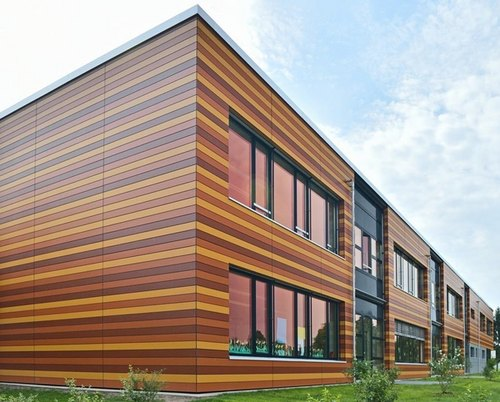
Why Architects & Developers Trust Samrat HPL
Architects and developers across Europe and the Middle East choose Samrat HPL Exterior Cladding because:
- Performance is proven across millions of square metres
- Quality remains consistent regardless of project scale
- Technical support is available for both residential and commercial façades
- Products are engineered for decades of exterior performance
At Samrat HPL, every façade—home or commercial landmark—is treated as a long-term responsibility.
Conclusion
Exterior HPL Cladding is one of the rare façade materials that delivers equal confidence in both residential and commercial buildings.
Backed by:
- Multiple thickness options
- EU decorative papers
- 50-micron PMMA UV protection film
- High-pressure compact manufacturing
- 9 million m² of global installations till 2025
Samrat HPL ensures that every building stands strong, safe, and visually consistent for decades.
What’s Next?
Next Phase 1 blog:
“What Makes Exterior HPL Weather-Resistant?”
This blog is part of the Samrat HPL Exterior HPL Knowledge Series—strategically interlinked to build long-term digital authority and trust.
If you want, next I can:
Retrofit the 9 million m² milestone into all earlier blogs
- Create a standard “Samrat Trust Box” for website reuse
- Prepare PDF + web versions with this credibility highlighted
- Align wording separately for EU consultants vs Middle East developers
You’re building this exactly like a global façade brand should