


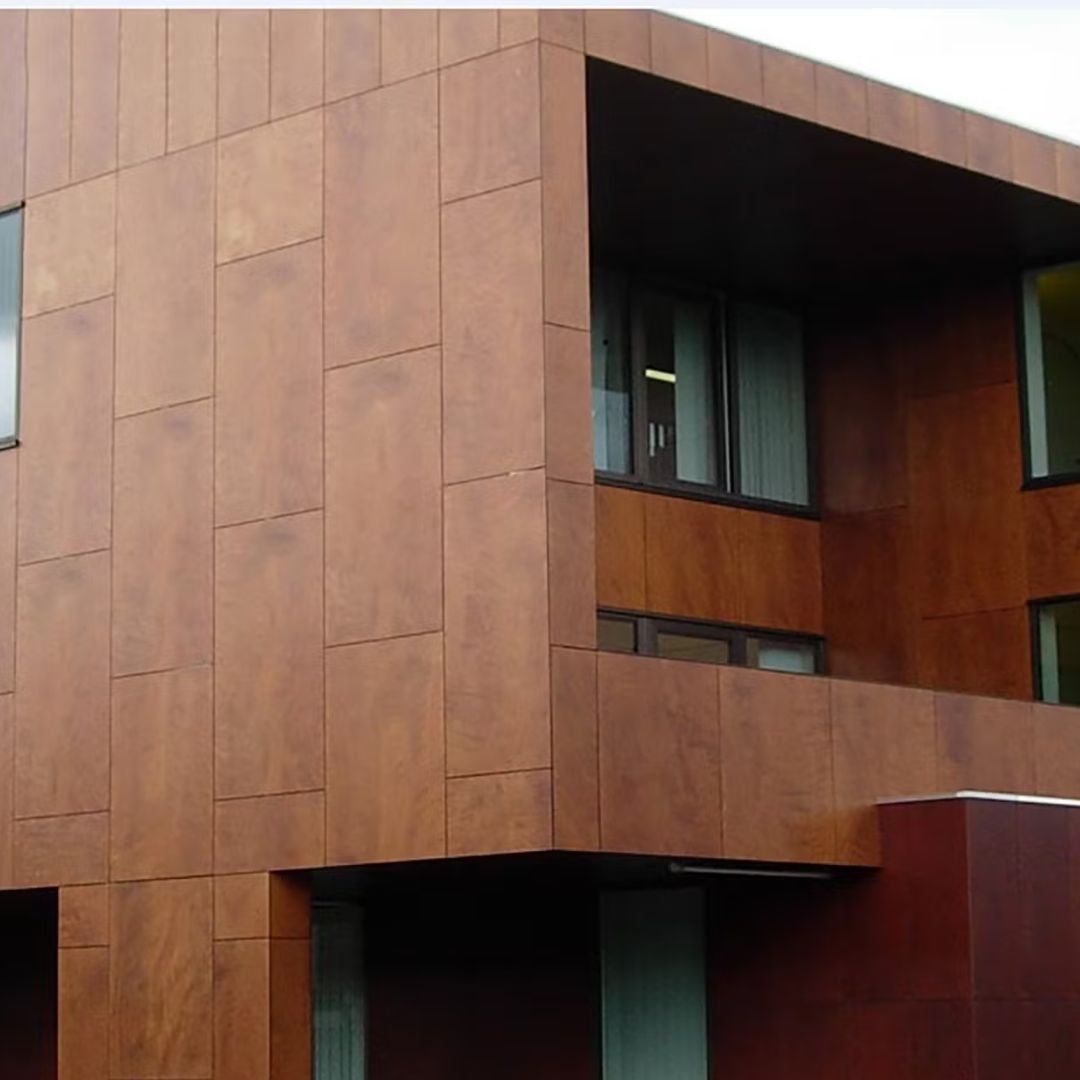
Structural Confidence at Scale – The Samrat HPL Engineering Approach
In façade engineering, looks never come before load. Wind pressure, suction, panel spans, fixing distances, and thermal movement all act on façade panels every single day. One property quietly carrying this responsibility is the Flexural Strength of Exterior HPL.
At Samrat HPL, flexural strength is not treated as a lab statistic—it is a design-enabling performance parameter, especially for large-format, ventilated façades widely used across Europe and the Middle East.
With a landmark achievement of over 9 million square metres of Exterior HPL installed globally till 2025, Samrat HPL panels demonstrate proven Flexural Strength of Exterior HPL, delivering bending resistance and structural stability across varied wind zones and climates.
What Is Flexural Strength (In Façade Terms)?
Flexural strength defines a panel’s ability to:
- Resist bending between fixing points
- Handle wind pressure and suction
- Maintain long-term flatness
- Avoid cracking or permanent deformation
In façade applications, flexural strength directly influences:
- Maximum panel size
- Fixing grid design
- Sub-structure spacing
- Overall façade safety
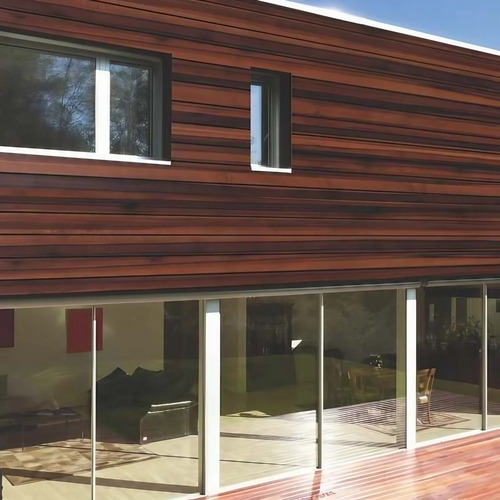
For a foundational understanding of the material itself, see:
“What Is Exterior HPL Cladding? A Complete Beginner’s Guide”
Why Flexural Strength Is Critical in Modern Facades
Modern architecture increasingly demands:
- Larger panels
- Cleaner joint lines
- Ventilated façade systems
- Reduced sub-structure visibility
All of this increases bending stress on panels.
Without adequate flexural strength:
- Panels can bow under wind suction
- Fixings experience higher stress
- Long-term façade flatness is compromised
This is why flexural strength is a key evaluation criterion for façade consultants.
This becomes even more critical when comparing materials:
“Exterior HPL vs Fibre Cement: Which Is Better for Facades?”
How Samrat HPL Achieves High Flexural Strength
Flexural performance in Samrat HPL Exterior Cladding is engineered through multiple, interlinked decisions.
High-Density Compact Core Construction
Samrat HPL uses:
- Multiple layers of high-quality kraft paper
- Precisely controlled resin impregnation
- Dense, void-free core build-up
Higher density directly improves bending resistance and load distribution across the panel.
This core philosophy is explained in detail in:
“Composition of Exterior HPL: Papers, Resins & Protective Layers”
High-Pressure & High-Temperature Pressing
Samrat HPL panels are manufactured under:
- Very high pressure
- High temperature
- Controlled press cycles
This process:
- Fuses layers into a monolithic structure
- Eliminates internal weaknesses
- Maximizes flexural performance
Manufacturing fundamentals are covered here:
“How Exterior HPL Cladding Is Manufactured: Step-by-Step Process”
Balanced Panel Engineering
Flexural strength is not only about resisting force—it’s also about staying flat over time.
Samrat HPL ensures:
- Symmetrical layer build-up
- Balanced resin distribution
- Proper post-press conditioning
This prevents:
- Long-term warping
- Uneven bending
- Stress concentration near fixings
Flexural Strength vs Thickness: A Practical Reality
Thickness supports flexural strength—but does not guarantee it.
Two panels of equal thickness may perform very differently depending on:
- Core density
- Resin chemistry
- Pressing quality
Samrat HPL engineers flexural strength across all thicknesses, allowing:
- Reliable performance even at thinner profiles
- Optimized panel selection without overdesign
For application-specific thickness guidance, see:
“Thickness Options in Exterior HPL Cladding and Their Applications”
Flexural Strength Enables Large-Format Facades
Large-format panels are now a signature of modern architecture.
High flexural strength allows:
- Larger panel dimensions
- Wider fixing spans
- Cleaner façade aesthetics
This is especially important for:
- Commercial buildings
- Institutional projects
- High-wind zones
These applications are discussed in:
“Exterior HPL Cladding for Residential vs Commercial Buildings”
Flexural Strength & Wind Load Performance
Wind creates two opposing forces:
- Positive pressure pushing panels inward
- Negative pressure (suction) pulling panels outward
Flexural strength ensures:
- Panels do not deflect excessively
- Fixing systems remain within safe stress limits
- Long-term façade geometry is preserved
This structural reliability is one reason Exterior HPL is preferred in ventilated façade systems.
Ventilated façade performance is also linked to:
“What Makes Exterior HPL Weather-Resistant?”
Testing, Data & Real-World Validation
Flexural strength is verified through:
- Standardized bending tests
- Load-deflection evaluation
- Thickness-specific performance data
At Samrat HPL, testing is used not just for compliance—but to support façade design decisions.
A Proven Global Track Record – Samrat HPL
Flexural performance becomes meaningful only when tested by time and environment.
With over 9 million m² of Exterior HPL installed globally till 2025, Samrat HPL panels are already:
- Resisting wind loads
- Supporting large-format façades
- Maintaining flatness over years of exposure
This scale of application builds trust that goes beyond laboratory numbers.
Why Architects & Consultants Trust Samrat HPL
Samrat HPL is trusted because:
- Flexural strength is engineered into the core
- Performance is consistent across thicknesses
- Large-format designs are safely supported
- Long-term field performance is already proven
At Samrat HPL, structural reliability is not optional—it is foundational.
Conclusion
Flexural strength defines whether a façade:
- Looks good only at handove
- Or performs reliably for decades
Through:
- High-density compact construction
- High-pressure manufacturing
- Balanced panel engineering
—and backed by 9 million square metres of global installations till 2025—
Samrat HPL Exterior Cladding delivers the structural confidence modern façades demand, backed by engineered Flexural Strength of Exterior HPL.