


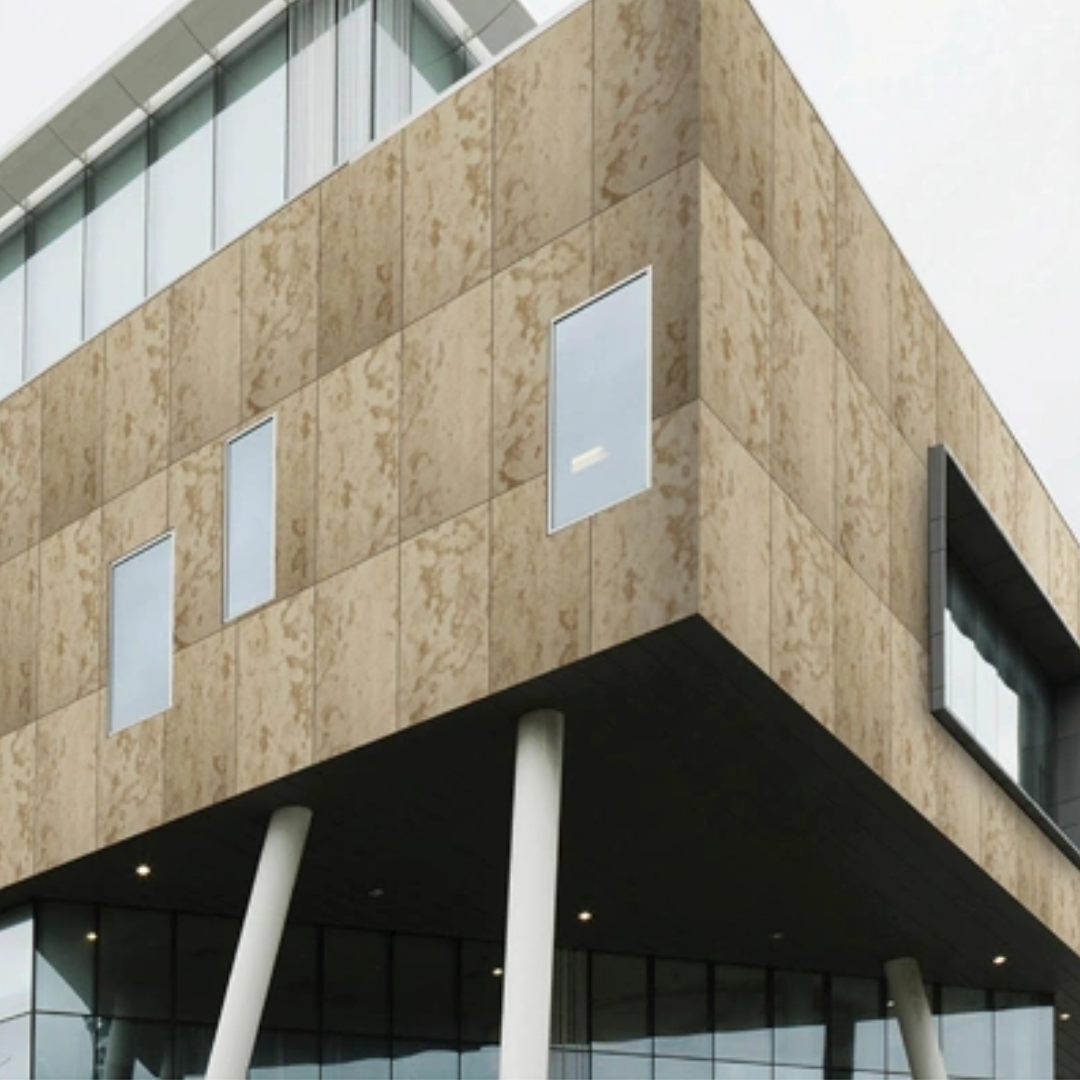
1) Fundamentals of Thermal Movement in Façade Materials
All façade materials undergo dimensional change when subjected to temperature variation. This behaviour, central to understanding Thermal Expansion in Exterior HPL, is governed by the Coefficient of Linear Thermal Expansion (CLTE), which defines how much a material expands or contracts per degree change in temperature.
In real building environments, façade panels are exposed to:
- Solar radiation causing surface temperatures to exceed ambient temperature
- Rapid cooling during night cycles
- Seasonal thermal swings (summer–winter)
- Thermal gradients between panel surface and rear side
For dark coloured façade panels under direct sun, surface temperatures can reach 70–80°C, even when ambient temperature is 30–35°C. This creates expansion stress across the panel area.
If thermal movement is not accommodated:
- Stress concentrates at fixing points
- Buckling or panel bowing may occur
- Micro-cracking near fasteners can develop
- Joint alignment may shift over time
Thus, dimensional stability and controlled expansion behaviour are critical performance parameters in ventilated façade systems, especially when evaluating thermal expansion in exterior HPL.
2) Thermal Behaviour of Exterior Compact HPL – Material Science View
Exterior Compact HPL is a thermoset composite material made of:
- Multiple layers of kraft paper
- Phenolic resin impregnation (core)
- Decorative melamine resin surface layers
- High-pressure consolidation
Because of this cross-linked thermoset structure:
- HPL does not soften under heat like thermoplastics
- Dimensional movement remains linear and predictable
- Structural integrity is maintained across temperature cycles
Typical thermal expansion range for compact HPL:
- Approx. 0.015–0.030 mm/m·K (direction dependent)
This means:
- A 3-meter panel exposed to a 40°C temperature change may expand only around 2–3 mm
- This movement can be safely managed through correct façade detailing
3) Directional Stability (Longitudinal vs Transverse Movement)
Like all paper-based composites, compact HPL has slightly different expansion behaviour in:
- Longitudinal direction (paper grain direction)
- Transverse direction
Samrat HPL controls this variation through:
- Multi-directional paper layering
- Symmetrical stack design
- Controlled resin distribution
This results in:
- Reduced anisotropic movement
- Uniform dimensional response
- Stable panel geometry
4) Role of High-Density Compact Core
Samrat Exterior HPL is produced under:
- High pressure consolidation
- Controlled curing temperatures
- Dense phenolic core formation
This high-density compact core contributes to:
- Low moisture absorption
- Reduced internal voids
- Structural stiffness
- Predictable expansion characteristics
Dense structure ensures:
- Expansion happens uniformly
- No internal delamination during thermal cycles
- Reduced risk of warpage
5) Hygrothermal Stability (Temperature + Moisture Interaction)
In real environments, temperature change is not the only factor. Panels are also exposed to:
- Humidity variation
- Rain exposure
- Freeze–thaw cycles
- Coastal moisture environments
Exterior Compact HPL performs well because:
- Phenolic resin matrix resists moisture penetration
- Surface melamine layer provides sealing
- PMMA UV protective film acts as an additional barrier
This results in:
- Minimal dimensional change due to moisture
- Stable hygrothermal performance
- Long-term panel flatness
6) Surface Heat Behaviour & UV Protective Layer
The 50-micron PMMA (Plexiglass) protective film plays a secondary role in thermal stability:
- Reflects part of solar radiation
- Protects surface resin from thermal ageing
- Maintains colour stability under heat exposure
- Reduces micro-cracking due to UV + heat synergy
This contributes to:
- Stable thermal response over years
- Reduced degradation of the decorative layer
7) Importance of Installation Engineering
Thermal movement is not eliminated — it is managed through system design.
Key façade engineering practices include:
Expansion gaps
- Allow panels to expand/contract freely
Oversized fixing holes
- Permit movement without stress concentration
Floating fixing systems
- One fixed point + multiple sliding points
Ventilated façade cavity
- Reduces heat build-up
- Equalizes panel temperature
In ventilated systems:
- Air circulation reduces temperature differential
- Thermal load on panel surface is reduced
8) Panel Size, Colour & Thermal Load
Thermal movement increases with:
- Larger panel sizes
- Dark colours (higher solar absorption)
- South/West facing façades
- High solar radiation regions
Samrat HPL panels are engineered to perform in:
- Middle East heat zones
- European freeze–thaw climates
- Coastal humidity regions
Proper installation design ensures:
- No stress concentration
- Long-term dimensional alignment
9) Long-Term Thermal Cycling Performance
Thermal stability must be evaluated over repeated cycles:
- Daily heat–cool cycles
- Seasonal expansion–contraction
- Multi-year weathering exposure
With over 9 million m² installed globally till 2025, Samrat HPL has undergone:
- Thousands of thermal cycles
- Exposure to extreme climate variations
- Long-term field performance validation
This real-world exposure confirms:
- Structural stability
- Dimensional reliability
- Controlled thermal behaviour
10) Why Dimensional Stability Matters in Façade Engineering
Thermal performance directly impacts:
- Panel flatness
- Joint alignment
- Fixing durability
- Façade aesthetics
- Maintenance frequency
Materials with poor thermal stability may show:
- Surface waviness
- Stress marks
- Fixing loosening
- Panel deformation
Samrat HPL’s engineered compact structure helps maintain:
- Geometric stability
- Visual uniformity
- Long service life
11) Engineering Summary
Samrat Exterior Compact HPL controls thermal expansion through:
- Dense phenolic compact core
- Balanced multi-layer construction
- Low CLTE behaviour
- Moisture-resistant resin system
- UV-stable PMMA protective surface
- Compatibility with ventilated façade systems
These factors together provide:
- Predictable dimensional movement
- Reduced internal stress
- Long-term façade alignment
12) Final Technical Conclusion
Thermal expansion is unavoidable in any exterior cladding system. The key is not eliminating movement but controlling it through:
- Material engineering
- Structural density
- Balanced panel construction
- Proper façade detailing
Samrat Exterior HPL is engineered to handle temperature-driven dimensional changes in a controlled, predictable, and stable manner, ensuring reliable performance across diverse climatic conditions for decades, with advanced control over thermal expansion in exterior HPL.