


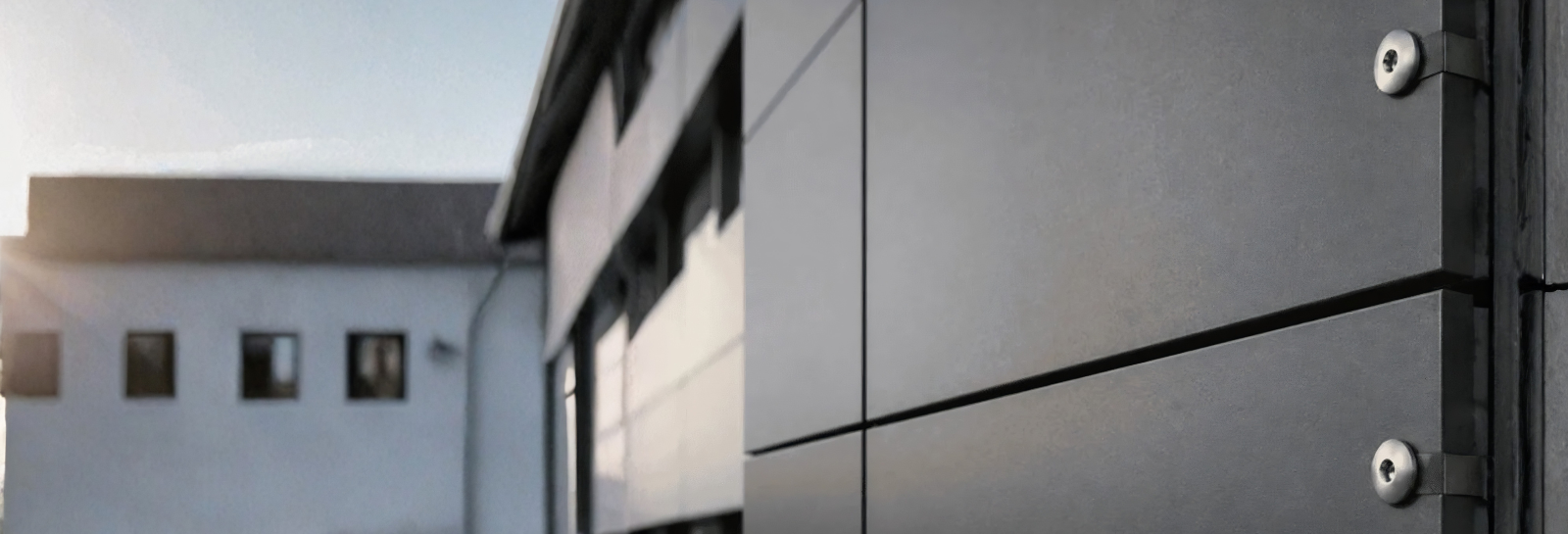
The Engineering Behind HPL Rivet Fixing, Thermal Movement & Long-Term Façade Performance
Exterior Compact HPL is one of the most durable façade materials used in modern ventilated rainscreen systems. When properly engineered and installed, it delivers exceptional long-term performance against ultraviolet radiation, moisture, wind loading, freeze-thaw cycles and continuous environmental exposure.
Yet, despite the excellent mechanical properties of Exterior Compact HPL, façade failures such as cracking around rivets, local panel distortion, buckling or enlarged fixing holes are still occasionally observed across the industry.
A common assumption is that these failures originate from poor laminate quality.
However, our experience tells a very different story.
With more than 9 million square metres of Exterior Compact HPL installed worldwide until 2025, Samrat HPL has supplied façade projects across Europe, the Middle East, Asia and several other climatic regions. Through continuous technical support, project inspections and discussions with façade consultants and installation teams, one conclusion has remained remarkably consistent:
The majority of long-term façade problems are not caused by the HPL panel itself—they are caused by incorrect installation engineering.
In many cases, laboratory testing confirms that the laminate continues to comply with the mechanical performance requirements of EN 438, while the actual cause of failure can be traced back to restrained thermal movement, incorrect rivet fixing, inadequate expansion provisions or improper fixing design.
Among all installation principles, none is more important—or more misunderstood—than the Fixed Point and Sliding Point concept.
Although this principle appears simple, it forms the foundation of every professionally engineered Exterior HPL façade. When correctly designed, it allows each panel to expand and contract naturally throughout its service life while remaining securely attached to the supporting aluminium substructure. When ignored, it can lead to progressive stress accumulation, premature cracking and ultimately façade failure.
This is why architects, façade consultants and contractors frequently search for topics such as:
- HPL Fixed Point
- Sliding Point HPL
- HPL Rivet Fixing
- Exterior HPL Installation Guide
- HPL Fixing Details
- Why HPL Panels Crack Around Rivets
- Exterior HPL Thermal Expansion
- HPL Façade Fixing System
This article explains the engineering science behind these concepts and why they are essential for achieving long-term façade performance.
Samrat Engineering Perspective
At Samrat HPL, manufacturing high-quality Exterior Compact HPL is only one part of delivering a successful façade.
The second—and equally important—part is ensuring that every panel is installed according to sound engineering principles.
This philosophy has been developed through decades of manufacturing experience and millions of square metres of successful installations across climates ranging from freezing European winters to intense Middle Eastern summers.
Our technical guidance therefore extends beyond the panel itself to include:
- Expansion gap design
- Fixed Point & Sliding Point principles
- Wind load considerations
- Rivet fixing systems
- Aluminium substructure recommendations
- Long-term façade durability
Because in façade engineering, the installation system is just as important as the panel itself.
Exterior HPL is an Engineered Façade Material—Not Just a Decorative Panel
One of the biggest misconceptions in the construction industry is that Compact HPL behaves as a completely rigid material that does not move after installation.
From an engineering standpoint, this is incorrect.
Exterior Compact HPL is a high-density thermoset composite, manufactured under high pressure and high temperature in accordance with EN 438 requirements. Although its dimensional stability is significantly better than many conventional building materials, it still responds to environmental changes in accordance with the laws of material science.
Every engineering material experiences dimensional movement when subjected to temperature variations.
This includes:
- Steel
- Aluminium
- Glass
- Fibre Cement
- Concrete
- Exterior Compact HPL
The critical engineering question is therefore not whether thermal movement occurs.
It always occurs.
The real question is:
Has the façade system been designed to accommodate that movement safely?
At Samrat HPL, this principle forms the basis of every installation recommendation because long-term durability depends not only on panel quality but equally on allowing the façade to behave exactly as engineering science predicts.
Understanding Thermal Expansion in Exterior Compact HPL
Every exterior façade experiences continuous thermal cycling throughout its service life.
Unlike interior building products, façade panels are exposed directly to solar radiation, ambient temperature fluctuations, wind, rainfall and seasonal climatic changes.
A common mistake during façade design is to consider only the surrounding air temperature.
In reality, the temperature of the panel surface is often significantly higher.
For example:
| Environmental Condition | Temperature |
|---|---|
| Ambient Air Temperature | 30°C |
| Dark Coloured HPL Surface | 65–75°C |
This means that although the surrounding environment may only experience a moderate increase in temperature, the Exterior Compact HPL panel itself may undergo a thermal variation exceeding 40°C.
Dark colours such as:
- RAL 9005 Black
- RAL 7016 Anthracite Grey
- Deep woodgrain decors
- Dark stone finishes
absorb considerably more solar energy than lighter shades, resulting in greater thermal expansion.
This behaviour is governed by a material property known as the Coefficient of Linear Thermal Expansion, which describes how much a material changes dimension in response to temperature.
Although the actual dimensional movement is generally measured in only a few millimetres, the forces generated when this movement is restrained can become extremely high.
For this reason, Samrat HPL develops its installation recommendations by considering not only the properties of the laminate, but also the behaviour of the complete façade system.
Thermal movement is therefore never treated as an installation inconvenience—it is considered an essential engineering parameter that must be incorporated into every façade design.
Why Thermal Expansion Creates Mechanical Stress
Thermal expansion itself is neither unusual nor undesirable.
It is a completely natural physical phenomenon.
The problem begins only when the panel is prevented from moving.
Imagine placing a steel beam between two rigid concrete walls.
As the temperature rises, the beam attempts to increase in length.
If sufficient clearance exists, the beam expands freely and no harmful stresses develop.
However, if both ends are rigidly restrained, the beam cannot expand.
Instead, the expansion force is converted into internal mechanical stress.
Exactly the same behaviour occurs in Exterior Compact HPL.
When the fixing system restrains the natural movement of the panel, the dimensional change that should have occurred is transformed into stress within the laminate.
This relationship is described by one of the most fundamental principles of engineering mechanics:
σ = E × ε
Where:
- σ = Internal Stress
- E = Modulus of Elasticity
- ε = Thermal Strain
In simple terms:
If movement is prevented, stress increases.
Over thousands of heating and cooling cycles during the service life of the façade, these stresses repeatedly concentrate around drilled holes, rivets and panel edges.
Eventually they may develop into:
- Cracks around fixing points
- Enlarged rivet holes
- Local panel deformation
- Surface bowing
- Reduced long-term façade performance
From Samrat HPL’s experience across thousands of projects, this is one of the most common root causes of façade defects that are incorrectly attributed to the laminate itself.
In reality, the panel did not fail because it expanded.
It failed because it was not permitted to expand.
The Engineering Principle Behind Fixed Point & Sliding Point
Every façade engineer faces two engineering requirements that appear contradictory.
The panel must remain securely attached to the building so that it can safely resist:
- Wind suction
- Wind pressure
- Dead loads
- Building movement
At the same time, that very same panel must also be free to expand and contract throughout seasonal temperature changes.
These two requirements cannot be achieved using conventional rigid fixing methods.
The engineering solution is the Fixed Point & Sliding Point principle.
Instead of treating every fixing identically, each fixing is assigned a specific structural function.
One fixing accurately positions the panel.
The remaining fixings allow controlled movement.
This simple yet highly effective engineering concept allows Exterior Compact HPL to behave as a dynamic façade material rather than a restrained rigid plate.
It is this principle that enables modern ventilated façades to maintain their appearance and structural integrity over decades of service.
What is a Fixed Point?
The Fixed Point is the mechanical reference point of the panel.
Its purpose is not simply to hold the panel in place.
Rather, it establishes the panel’s exact location relative to the aluminium support structure.
The Fixed Point prevents the panel from:
- Sliding vertically
- Moving horizontally
- Rotating under service loads
Because it defines the permanent position of the panel, only one Fixed Point should normally be provided on each panel.
Every other fixing is then designed to accommodate thermal movement.
This principle forms the basis of modern Exterior HPL façade engineering and is recommended by façade engineering practices worldwide.
Excellent. This second part is where we can truly demonstrate EEAT (Experience, Expertise, Authoritativeness, Trustworthiness). Rather than simply explaining what a Sliding Point is, we’ll explain the engineering mechanics, discuss failure analysis, cite European standards, and naturally reinforce Samrat HPL’s technical expertise.
What is a Sliding Point?
If the Fixed Point establishes the permanent reference position of the panel, the Sliding Points ensure that the panel remains stress-free throughout its entire service life.
Every fixing other than the Fixed Point is designed as a Sliding Point.
Unlike conventional rigid fixings, a Sliding Point is intentionally engineered to permit controlled dimensional movement while continuing to securely support the panel against wind loads and gravity.
In simple terms:
- Fixed Point → Locates the panel
- Sliding Point → Allows the panel to move
Although this principle appears straightforward, it is one of the most important engineering concepts in ventilated façade design and is recommended in Exterior HPL installation guidelines based on EN 438 and recognised façade engineering practices.
Why Oversized Holes Are Essential in Sliding Points
One of the most common installation mistakes observed by the technical team at Samrat HPL is the use of identical hole diameters for every rivet.
While this may appear to improve fixing strength, it actually creates the opposite effect.
A Sliding Point functions correctly only when the drilled hole is intentionally larger than the rivet shank.
This additional clearance allows the HPL panel to expand and contract without transferring excessive stress into the fixing.
Engineering Principle
As the panel temperature changes, its dimensions change proportionally.
If every rivet tightly grips the panel, friction prevents this movement.
The panel then attempts to overcome this restraint by generating internal tensile and compressive stresses.
Over time, these stresses accumulate around the fixing holes, resulting in:
- Radial cracking around rivets
- Elongated holes
- Local deformation
- Buckling
- Premature façade deterioration
For this reason, Samrat HPL always recommends that Sliding Points are designed with the appropriate oversized hole dimensions specified by the approved installation system, ensuring that thermal movement can occur without inducing harmful mechanical stresses.
Understanding Stress Concentration Around Rivets
From a mechanical engineering perspective, every drilled hole represents a natural point of stress concentration.
When the panel is free to move, the stress around the rivet remains relatively low.
However, if thermal movement is restrained, the rivet hole becomes the location where these stresses are concentrated.
The process typically develops as follows:
- Daily temperature changes cause the panel to expand and contract.
- Movement is restrained by rigid fixings.
- Stress accumulates around the rivet holes.
- Microscopic cracks begin to develop.
- Repeated thermal cycling causes these cracks to propagate.
- Visible cracking eventually appears around the fixing.
This process is known as fatigue failure.
Importantly, fatigue failure does not occur because the panel is weak—it occurs because the panel is repeatedly subjected to stresses that it was never intended to resist.
This is one of the reasons why façade failures often appear only after several years rather than immediately after installation.
Thermal Cycling – The Hidden Cause of Long-Term Damage
A façade does not experience thermal movement only once.
It expands and contracts every single day.
A building installed today may experience:
- Approximately 365 thermal cycles every year
- More than 7,000 expansion and contraction cycles over twenty years
Each individual movement may only be a fraction of a millimetre.
However, over thousands of cycles, repeated restraint causes cumulative fatigue within the fixing area.
This is why many façade failures become visible only after five, ten or even fifteen years.
The installation may appear perfect on the day of completion, yet concealed stresses continue to develop during every seasonal change.
At Samrat HPL, this understanding forms an important part of our installation philosophy. A façade should not only look good on the day it is installed—it should continue to perform reliably throughout decades of service.
Interaction Between Expansion Gaps and Sliding Points
One of the most common misconceptions is that providing expansion gaps alone is sufficient.
This is technically incorrect.
Expansion gaps and Sliding Points perform different but complementary functions.
Expansion Gaps
Expansion gaps provide space between adjacent panels, allowing the overall façade layout to accommodate dimensional changes.
Sliding Points
Sliding Points permit movement within each individual panel, preventing stresses from accumulating around the fixings.
A façade system requires both.
If expansion gaps are provided but every rivet restrains the panel, movement remains restricted.
Conversely, if Sliding Points are correctly designed but the panels are installed without adequate joint spacing, adjacent panels may still collide during expansion.
The two systems must therefore be engineered together.
➡️ Related Blog: Expansion Gaps in Exterior HPL: Why They Are Critical for Preventing Cracks, Warping & Façade Failure
Wind Loads and Thermal Movement – Two Engineering Forces Acting Together
A common misconception is that rivets are designed solely to resist wind loads.
In reality, every fixing in an Exterior HPL façade must simultaneously accommodate:
- Wind suction
- Wind pressure
- Dead load
- Thermal expansion
- Building movement
These actions occur together throughout the service life of the façade.
European structural design standards, including EN 1991-1-4 (Eurocode – Wind Actions), require designers to consider wind loading when specifying façade fixing systems.
However, resisting wind loads should never prevent the panel from moving thermally.
This balance between structural restraint and thermal freedom is precisely what the Fixed Point & Sliding Point principle achieves.
Common Installation Mistakes Observed in Exterior HPL Projects
Through technical discussions with architects, contractors and installation partners across international projects, Samrat HPL has identified several recurring installation errors.
❌ Creating Multiple Fixed Points
Only one fixing should normally act as the Fixed Point.
Multiple restrained fixings prevent natural thermal movement.
❌ Drilling Every Hole to the Same Diameter
This unintentionally converts every Sliding Point into another Fixed Point.
❌ Over-Tightening Rivets
Excessive clamping force increases friction and restricts movement, even when oversized holes are provided.
❌ Ignoring Expansion Gaps
Without sufficient clearance between adjacent panels, thermal expansion may cause panel edges to bear against each other, generating additional stresses.
❌ Incorrect Aluminium Substructure Alignment
A poorly aligned support system introduces unnecessary stresses before thermal movement even begins.
❌ Assuming Dark Colours Behave Like Light Colours
Dark decorative finishes absorb considerably more solar radiation and therefore require particular attention during fixing design.
The Samrat HPL Engineering Philosophy
At Samrat HPL, we believe that manufacturing a high-quality Exterior Compact HPL panel is only the first step towards achieving a durable façade.
The long-term success of every project depends equally on:
- Correct panel engineering
- Appropriate aluminium support systems
- Proper expansion gap design
- Accurate Fixed Point & Sliding Point installation
- Qualified façade installation practices
With more than 9 million m² of Exterior Compact HPL installed globally, our technical team has seen that the overwhelming majority of field issues originate from installation errors rather than deficiencies in the laminate itself.
For this reason, our commitment extends beyond manufacturing.
We actively support architects, façade consultants and contractors by sharing engineering knowledge that helps maximise the service life of every façade.
Frequently Asked Questions (SEO Optimised)
What is a Fixed Point in Exterior HPL?
A Fixed Point is the primary fixing that establishes the permanent position of the panel while preventing unwanted movement relative to the supporting structure.
What is a Sliding Point?
A Sliding Point is a fixing designed to securely support the panel while allowing controlled thermal expansion and contraction.
Why are oversized holes required for HPL rivet fixing?
Oversized holes reduce restraint, allowing thermal movement and preventing stress concentration around the fixing.
Can incorrect rivet fixing cause Exterior HPL panels to crack?
Yes. Restrained thermal movement is one of the most common causes of cracking around rivets.
Why do HPL panels crack around fixings after several years?
Repeated daily thermal expansion and contraction can create fatigue around restrained fixing points, eventually leading to visible cracks.
Do dark coloured HPL panels expand more?
Dark colours absorb more solar radiation, resulting in higher surface temperatures and greater thermal movement than lighter colours.
What standards apply to Exterior HPL installation?
Product performance is generally evaluated in accordance with EN 438, while structural design of façade systems should also consider applicable Eurocode requirements such as EN 1991-1-4 for wind actions.
Continue Learning with the Samrat HPL Technical Knowledge Centre
To further understand the engineering principles behind Exterior Compact HPL, explore these related technical guides:
- Expansion Gaps in Exterior HPL: Why They Are Critical
- How Exterior HPL Cladding Is Installed & Common Installation Mistakes
- Wind Load Performance of Exterior HPL Façade Panels
- Why High Pressure & High Temperature Are Critical for Exterior HPL Durability
- Density of Exterior HPL: Why It Matters for Strength & Durability
- EN 438 Explained: What It Means for Exterior HPL
- Lifespan of Exterior HPL Cladding: What to Expect
- REACH, VOC & E05 Explained for Exterior HPL
Conclusion
A properly designed Exterior HPL façade is not defined solely by the quality of the laminate—it is defined by the quality of its engineering.
The Fixed Point & Sliding Point principle is one of the most fundamental requirements for accommodating thermal movement while maintaining structural integrity. When correctly implemented alongside appropriate expansion gaps, wind load design and installation practices, it significantly reduces the risk of cracking, buckling and premature façade failure.
With more than 9 million m² of Exterior Compact HPL installed worldwide, Samrat HPL has developed its technical recommendations through real project experience, engineering principles and continuous collaboration with architects, consultants and installers. This practical knowledge forms the foundation of our commitment to helping every façade achieve safe, reliable and long-lasting performance.
Final Positioning
At Samrat HPL, façade engineering extends far beyond manufacturing high-quality Exterior Compact HPL panels. Through a 100% dedicated focus on exterior cladding, advanced technical support and proven installation principles—including the Fixed Point & Sliding Point concept—we help architects and contractors create façade systems that are engineered to accommodate thermal movement, withstand environmental loads and deliver reliable performance for decades.