


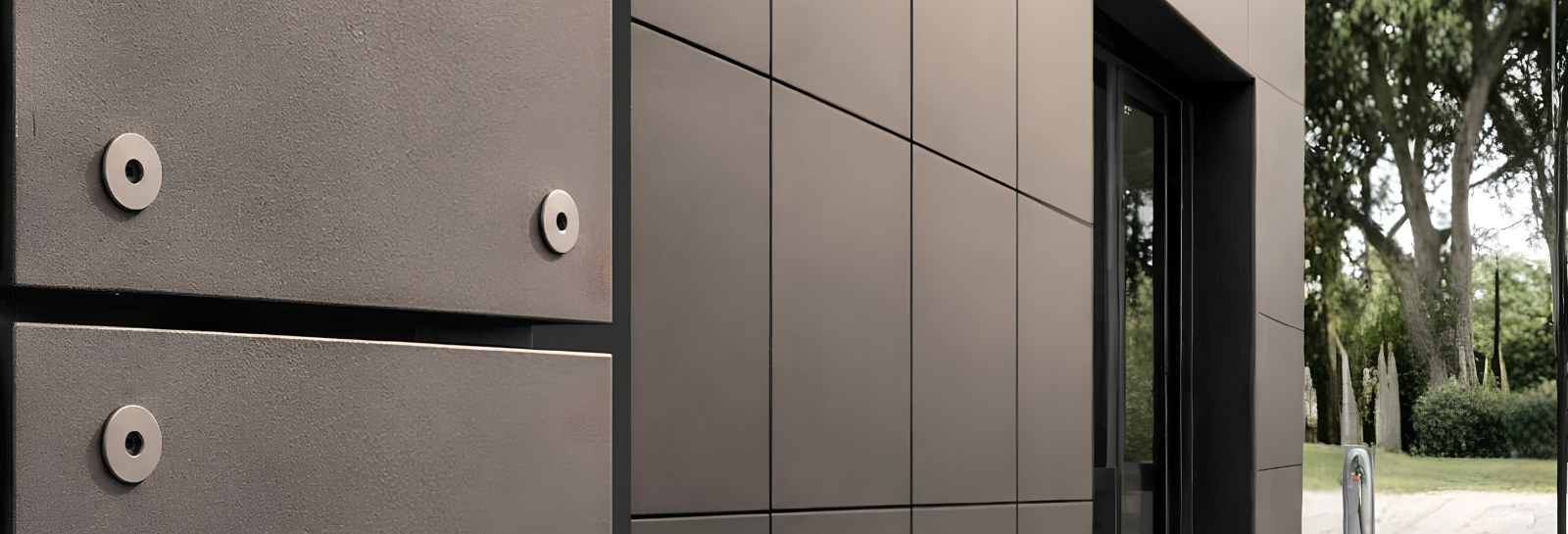
Expansion Gaps in Exterior HPL: Why They Are Critical for Preventing Cracks, Warping & Facade Failure
The Science of Thermal Expansion, Joint Design & Long-Term Performance in Exterior HPL Facade Panels
When architects and installers discuss Exterior HPL cladding, most attention is given to:
- Panel thickness
- Fire performance
- Colours and finishes
- Wind load resistance
- Fixing systems
However, one of the most important aspects of Exterior HPL installation is often underestimated:
Expansion gaps.
In reality, a significant percentage of façade failures involving Exterior HPL are not caused by the panel itself but by incorrect allowance for thermal movement.
This is why some of the most common searches on Google today include:
- Why do HPL panels crack?
- HPL panel cracking issues
- HPL facade failure reasons
- Exterior HPL installation mistakes
- HPL thermal expansion
- Correct gap between HPL panels
The answer to many of these questions is surprisingly simple:Insufficient expansion gaps.
Why Do Exterior HPL Panels Expand?
A common misconception is that HPL is a completely rigid material.
While Exterior Compact HPL is highly stable, it is still an engineered material that responds to environmental changes.
Throughout its service life, a façade panel is continuously exposed to:
- Solar radiation
- Seasonal temperature changes
- Day-night temperature fluctuations
- Humidity variations
As temperatures rise, materials expand.
As temperatures decrease, materials contract.
This phenomenon is known as:
Thermal Expansion
and it affects virtually every construction material including:
- Steel
- Aluminium
- Glass
- Fibre Cement
- HPL
The difference is not whether expansion occurs, but whether the façade system has been designed to accommodate it.
Understanding Thermal Expansion in Exterior HPL
When sunlight strikes a dark façade panel, the surface temperature can easily reach:
- 60°C
- 70°C
- Sometimes even higher even when the ambient temperature is much lower.
A black façade panel installed in Southern Europe or the Middle East can experience temperature variations exceeding 50°C within a single day.
This thermal movement creates dimensional changes within the panel.
Although the movement appears small, the forces generated can be extremely large when expansion is restricted.
Why Expansion Gaps Are Critical
Expansion gaps provide space for the panel to move naturally.
Think of it like railway tracks.
Without expansion joints, rails would bend and distort during hot weather.
The same principle applies to façade panels.
Proper expansion gaps allow:
✔ Thermal movement
✔ Dimensional stability
✔ Stress relief
✔ Long-term façade performance
Without expansion gaps, movement forces are transferred directly into:
- Rivets
- Fasteners
- Substructures
- Panel edges
This is where problems begin.
What Happens If Expansion Gaps Are Ignored?
Many installers assume:
“The movement is so small, it won’t matter.”
In reality, even a few millimetres of restricted movement can generate significant internal stresses.
Common failures include
1. Panel Cracking
The most common symptom.
Typically seen:
- Around rivets
- Near drilled holes
- At corners
Because these locations become stress concentration points.
2. Panel Buckling
When expansion is prevented, the panel seeks another way to release stress.
The result can be:
- Bowing
- Distortion
- Visible waves on the façade
3. Joint Closure
Panels installed too tightly can expand until:
- Expansion gaps disappear
- Panel edges touch each other
This creates even greater stresses.
4. Fastener Failure
Thermal movement loads can be transferred into:
- Rivets
- Screws
- Anchors
resulting in premature fixing system failure.
The Fixed Point & Sliding Point Principle
One of the most important concepts in Exterior HPL installation is:
Fixed Point + Sliding Point Design
This principle exists because thermal movement cannot be stopped.
It must be managed.
Fixed Point
A single fixing location is designated as:
The reference point.
This point controls the panel position.
Sliding Points
All remaining fixings allow movement.
This permits:
- Expansion
- Contraction
- Stress-free movement without creating internal forces.
Why Hole Diameter Matters
Another common installation mistake involves drilling.
Many installers drill holes that are too tight.
This effectively locks the panel in place.
For Exterior HPL:
- Fixed point holes are precise
- Sliding point holes are oversized
This allows movement around the fixing.
Without oversized holes:
- Expansion becomes restricted
- Cracks may develop
Recommended Joint Spacing for Exterior HPL
While project-specific calculations should always be performed, typical façade installations generally provide:
Horizontal Joint
8–10 mm
Vertical Joint
8–10 mm
These gaps accommodate thermal movement while maintaining visual aesthetics.
Why Dark Colours Need More Attention
Dark colours absorb significantly more solar energy.
For example:
- Black
- Anthracite
- Dark grey
can become substantially hotter than:
- White
- Light grey
- Beige
This means:
Dark panels experience greater thermal movement.
Consequently, proper expansion gap design becomes even more important.
Expansion Gaps and Wind Load Performance
Expansion gaps are not only related to temperature.
They also influence:
- Wind load behaviour
- Dynamic façade movement
- Structural stress distribution
A properly designed façade system combines:
- Expansion gaps
- Correct fixing design
- Wind load calculations
to achieve long-term performance.
➡️ Related Blog:
Wind Load Performance of Exterior HPL Facade Panels
The Relationship Between Expansion Gaps and Panel Lifespan
Many people ask:
How long does HPL cladding last?
The answer depends heavily on installation quality.
Even the best Exterior HPL panel can fail prematurely if thermal movement is restricted.
Conversely, a correctly installed panel can provide decades of reliable service.
➡️ Related Blog:
How Long Does Exterior HPL Cladding Last?
Why Expansion Gaps Are Even More Important for High-Density HPL
High-quality Exterior HPL panels are manufactured with:
- High pressure
- High temperature
- High density
This creates a highly durable structure.
However:
A stronger panel does not eliminate thermal expansion.
It simply means the panel can withstand environmental stresses better when movement is properly accommodated.
➡️ Related Blogs:
- Why High Pressure & High Temperature Are Critical for Exterior HPL Durability
- Density of Exterior HPL: Why It Matters for Strength, Impact Resistance & Durability
Common Installation Mistakes Related to Expansion Gaps
The most common HPL installation mistakes include:
❌ No expansion gap between panels
❌ Hole diameter too small
❌ No fixed-point/sliding-point concept
❌ Fasteners tightened excessively
❌ Ignoring dark-colour heat buildup
❌ Incorrect substructure alignment
Almost all of these can eventually lead to:
- Cracking
- Warping
- Buckling
- Facade failure
➡️ Related Blog:
How Exterior HPL Cladding Is Installed and Common Installation Mistakes
The Samrat HPL Approach
At Samrat Exterior HPL, installation recommendations are developed around real-world façade performance.
With over:
9 million m² installed globally till 2025
the focus extends beyond manufacturing panels to ensuring they perform correctly throughout their service life.
This includes guidance on:
- Joint design
- Thermal movement
- Fixing systems
- Wind load considerations
- Long-term durability
Frequently Asked Questions (SEO Section)
Why do HPL panels need expansion gaps?
Because Exterior HPL expands and contracts with temperature changes. Expansion gaps allow this movement to occur safely.
What happens if HPL panels are installed without gaps?
Panels may crack, buckle, distort, or transfer excessive stress into the fixing system.
What is the correct gap between HPL panels?
Typical façade installations use approximately 8–10 mm joints, subject to project-specific calculations.
Why do HPL panels crack around rivets?
Usually because thermal movement is restricted and stress concentrates around fixing points.
What is the fixed-point and sliding-point principle?
A system where one fixing point controls panel position while all other fixings allow thermal movement.
Related Technical Blogs
👉 How Exterior HPL Cladding Is Installed and Common Installation Mistakes
👉 Wind Load Performance of Exterior HPL Facade Panels
👉 How Long Does Exterior HPL Cladding Last?
👉 Why High Pressure & High Temperature Are Critical for Exterior HPL Durability
👉 Density of Exterior HPL: Why It Matters for Strength, Impact Resistance & Durability
👉 Why Exterior HPL Does Not Delaminate Over Time
Final Thought
Most façade failures blamed on Exterior HPL are often not material failures at all.
They are movement-management failures.
Expansion gaps may appear to be one of the smallest details in a façade system, but they play one of the biggest roles in ensuring long-term performance, stability, and durability.
When thermal movement is properly accommodated, Exterior HPL remains one of the most reliable, durable, and low-maintenance façade materials available today.