


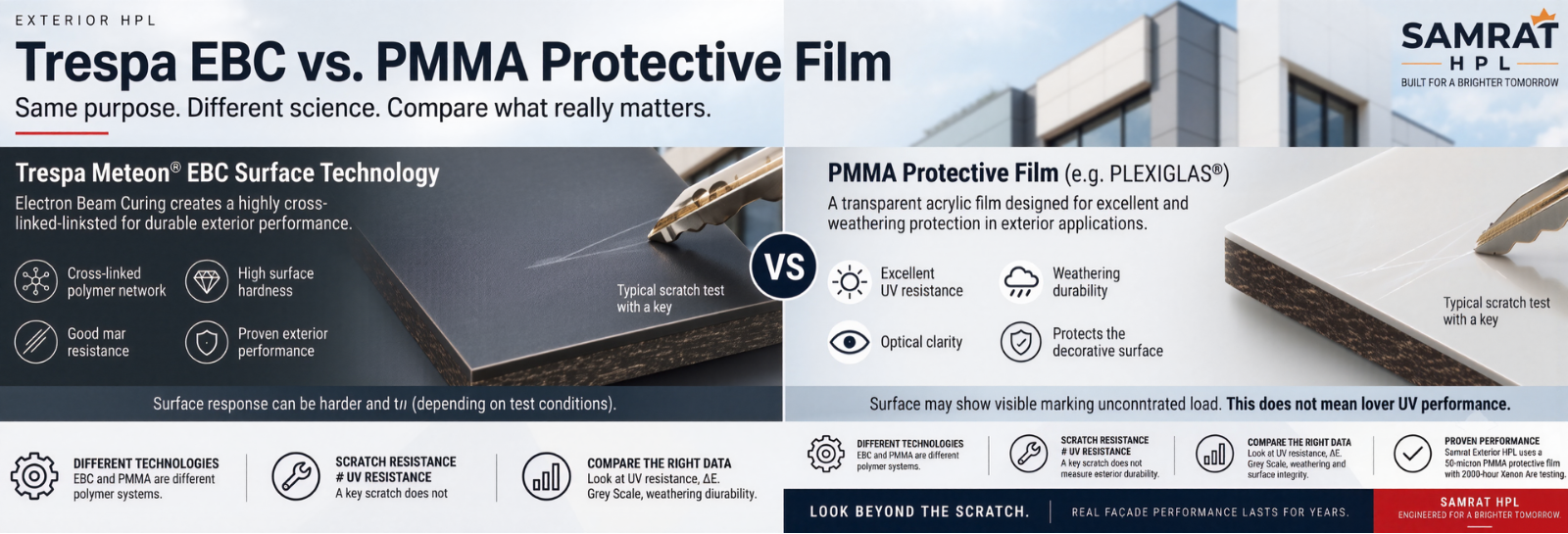
Trespa EBC vs. PMMA Protective Film in Exterior HPL: A Materials-Science Comparison
When architects, façade consultants or installers compare Trespa Meteon® Exterior HPL with PMMA-protected Exterior HPL, one difference can sometimes be noticed immediately: the surfaces may respond differently to scratching.
For example, scratching both panels with a key may leave a more visible mark on one surface than the other.
This can lead to a quick conclusion:
“The panel that scratches less must have better exterior protection.”
But scientifically, that is not necessarily correct.
Scratch resistance and UV/weathering resistance are different material properties.
The reason the two surfaces behave differently starts with their polymer chemistry.
What Is Trespa EBC Technology?
Trespa is associated with Electron Beam Curing (EBC) surface technology for its exterior HPL panels.
EBC uses high-energy electrons to cure a specially formulated surface system, creating a highly cross-linked polymer network.
Cross-linking restricts movement between polymer chains. Depending on the formulation, this can contribute to properties such as surface hardness, mar resistance and resistance to localised deformation.
This helps explain why an EBC surface may respond differently during a manual scratch test.
What Is PMMA Protective Film?
PMMA—poly(methyl methacrylate)—is a transparent acrylic thermoplastic widely used in outdoor applications because of its optical clarity and weathering characteristics.
At Samrat Exterior HPL, we use a 50-micron PMMA protective surface system over the decorative surface of our Exterior HPL.
Its purpose is particularly focused on protecting the decorative layer against UV exposure and long-term exterior weathering.
PMMA and EBC therefore use different polymer architectures.
Different chemistry naturally means different surface behaviour.
Why Can the Scratch Test Look Different?
An EBC-cured surface contains a highly cross-linked polymer network.
PMMA is a thermoplastic polymer with different molecular-chain behaviour.
Under concentrated pressure from something like a key, the two surfaces can therefore respond differently.
One may show less visible marking under a particular scratching action, while another may show localised deformation more readily.
But this tells us mainly about mechanical surface behaviour.
It does not automatically tell us which system provides better UV protection or long-term façade performance.
Scratch Resistance Is Not UV Resistance
This is the most important point in a Trespa vs. PMMA Exterior HPL comparison.
Scratch resistance measures how a surface responds mechanically when a hard object moves across it.
UV resistance evaluates how the material responds to prolonged ultraviolet radiation.
Exterior weathering performance goes further and considers the combined effects of UV, sunlight, rain, moisture and temperature cycling.
These properties are related to overall product performance—but they are not interchangeable.
Therefore:
A surface scratching less does not automatically prove that it has better UV resistance.
And equally:
Strong UV/weathering performance does not mean that a surface must behave identically in a scratch test.
Why a Key Scratch Test Can Be Misleading
Imagine an installer scratches a Trespa Meteon panel and a PMMA-protected Exterior HPL panel with a key.
One shows less marking.
What has actually been tested?
Primarily, the response of two different polymer surfaces to an uncontrolled concentrated mechanical load.
The test has not measured:
- UV resistance
- ΔE colour change
- Grey Scale
- Accelerated weathering
- Surface adhesion
- Delamination resistance
- Long-term façade durability
Even the scratching force itself is uncontrolled.
Was exactly the same pressure applied? Was the angle identical? Was the same part of the key used?
A key can demonstrate that two surfaces behave differently.
It cannot simulate years of exterior weathering.
How Should Exterior HPL Actually Be Compared?
For an exterior façade, the better comparison is controlled technical evidence.
Architects and façade consultants should consider:
Accelerated weathering: How does the panel perform after prolonged Xenon Arc or other recognised weathering exposure?
ΔE colour change: How much did the colour actually change after testing?
Grey Scale: What visible change occurred following exposure?
Surface integrity: Did the surface show cracking, peeling, blistering or delamination?
Scratch resistance: This can certainly be compared—but preferably through a controlled, repeatable test rather than a key.
Most importantly, results should only be compared when test standards and conditions are comparable.
Trespa EBC vs. PMMA: Simple Comparison
| Property | EBC Surface Technology | PMMA Protective Film |
|---|---|---|
| Polymer Type | Highly cross-linked cured surface | Thermoplastic acrylic |
| Surface Behaviour | Influenced by cross-linked network | Different thermoplastic response |
| Exterior Role | Surface/exterior protection | UV & weathering protection |
| Scratch Behaviour | Depends on formulation and test | Depends on film and test conditions |
| Does key scratching measure UV resistance? | No | No |
| Should weathering be tested separately? | Yes | Yes |
Neither technology should be judged from one property alone.
Trespa vs. Samrat HPL: Compare the Right Properties
Trespa represents one established approach to Exterior HPL surface engineering.
Samrat Exterior HPL uses a different approach—a 50-micron PMMA protective surface system.
Rather than claiming that one technology must outperform the other in every characteristic, it is more technically accurate to recognise that different polymer technologies can have different strengths and surface behaviour.
Samrat Exterior HPL has undergone 3000-hour Xenon Arc accelerated weathering testing, allowing exterior performance to be evaluated through controlled testing rather than an informal surface demonstration.
When comparing Trespa vs. Samrat HPL, look at the complete performance picture:
UV resistance + ΔE + Grey Scale + weathering + surface integrity + delamination resistance + mechanical performance + real-world façade history.
Scratch resistance can be part of that comparison.
It should not become the entire comparison.
Look Beyond the Scratch
A key scratch may demonstrate something real:
EBC and PMMA surfaces have different mechanical behaviour.
But it does not answer the bigger question:
How will the façade look and perform after years outdoors?
That requires proper weathering data, colour-change measurements, surface evaluation and long-term project experience.
For architects, distributors and installers comparing Trespa EBC with PMMA Exterior HPL, the message is therefore simple:
Don’t judge an exterior façade technology from a five-second scratch test. Judge it by the properties that matter after years on the building.
Samrat Exterior HPL
Specialists in Exterior HPL Manufacturing
Samrat manufactures Exterior Compact HPL using a 50-micron PMMA protective surface system.
With more than 9 million m² of Exterior HPL installed globally, our focus is on measurable long-term façade performance—including UV protection, colour stability and exterior weathering.