


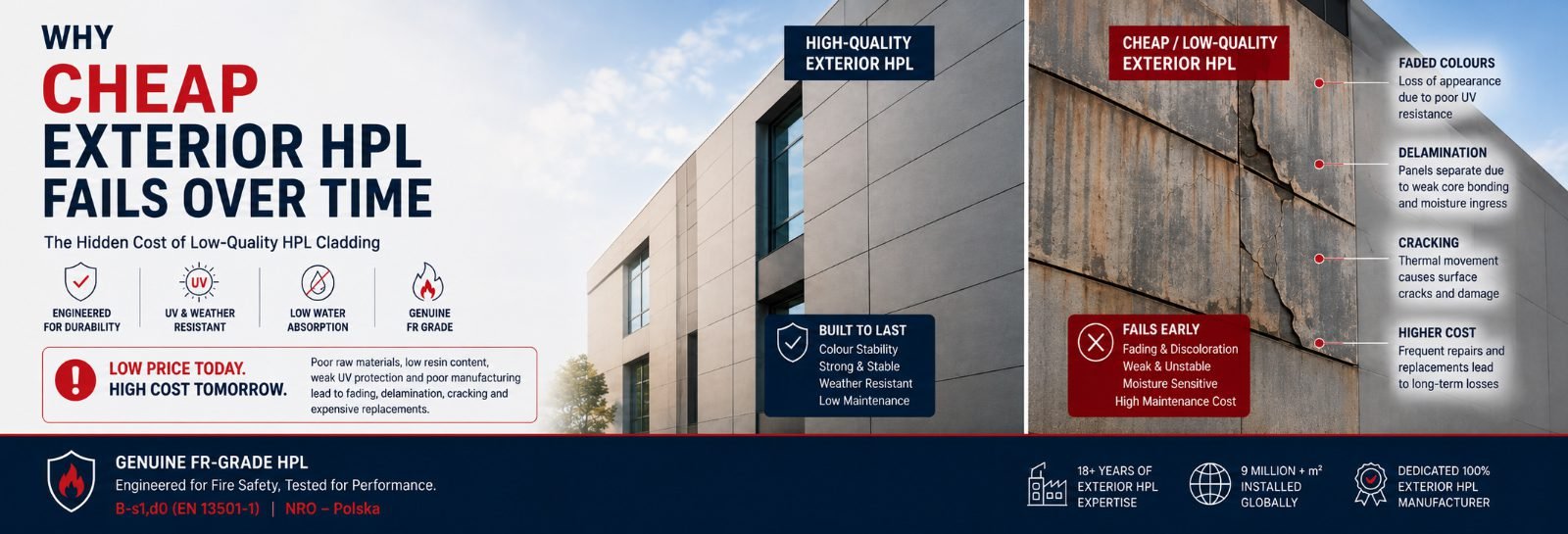
Why Cheap Exterior HPL Fails Over Time: The Hidden Cost of Low-Quality HPL Cladding
Why Resin Quality, Density, UV Protection, Manufacturing Discipline and Genuine FR-Grade Construction Matter More Than the Initial Price
When two Exterior HPL panels are placed next to each other in a showroom, they can look remarkably similar.
Same colour.
Same thickness.
Same size.
Similar surface finish.
One may even cost considerably less.
So why shouldn’t the buyer simply choose the cheaper Exterior HPL?
Because the real difference between two façade panels often becomes visible not on Day 1—but after years of exposure to sunlight, rain, heat, cold, wind and thousands of thermal cycles.
That is when differences in resin chemistry, density, decorative paper, pigments, UV protection, pressing conditions, curing quality and fire-retardant formulation begin to matter.
And this leads to one of the most important principles when buying façade materials:
The cheapest Exterior HPL panel is not necessarily the lowest-cost façade.
A façade should be evaluated by its life-cycle performance, not simply its price per square metre.
At Samrat Exterior HPL, our manufacturing ecosystem is focused specifically on Exterior Compact HPL. Years of façade experience have repeatedly demonstrated that small compromises hidden inside a panel can become very expensive once that panel is installed several floors above the ground.
Let’s understand why.
1. What Is Exterior HPL Actually Expected to Survive?
Exterior HPL is not ordinary decorative laminate.
A façade panel spends its entire working life exposed to conditions such as:
- Direct sunlight and UV radiation
- High and low temperatures
- Rapid temperature changes
- Rain and humidity
- Frost, snow and ice
- Wind pressure and suction
- Pollution
- Mechanical stresses
- Repeated expansion and contraction
EN 438-6 specifically covers Exterior-grade Compact HPL produced by the high-pressure process and intended for outdoor exposure including sunlight, rain and frost.
This is an important distinction.
A panel looking like Exterior HPL does not automatically mean it will provide the long-term performance expected from properly engineered Exterior Compact HPL.
Read More → EN 438 Explained: Understanding the Standard for Exterior HPL
2. Where Can Manufacturers Reduce the Cost of Exterior HPL?
This is where the discussion becomes interesting.
The appearance of an HPL panel is only its visible surface.
Much of its long-term performance is determined by things the buyer cannot immediately see:
Inside the panel are decisions concerning:
- Kraft paper quality
- Phenolic resin formulation
- Resin impregnation
- Decorative paper quality
- Pigment selection
- Pressing pressure
- Pressing temperature
- Curing cycle
- Density
- UV-protective technology
- Quality-control consistency
- Fire-retardant formulation where FR performance is required
Reducing manufacturing cost in any of these areas may not necessarily create an immediate visible defect.
That is precisely why judging Exterior HPL only by appearance and price can be misleading.
3. Resin Chemistry: The Invisible Backbone of HPL
The core of Exterior Compact HPL consists primarily of layers of kraft paper impregnated with thermosetting resin.
During pressing, the resin system cures and creates a dense cross-linked structure.
Good resin impregnation and controlled curing contribute to:
- Internal bonding
- Moisture resistance
- Mechanical strength
- Dimensional stability
- Long-term durability
If resin chemistry or curing is compromised merely to reduce manufacturing costs, the effect may only become apparent after prolonged environmental exposure.
This is why Exterior HPL resin quality is one of the most important—and least visible—parameters a buyer should understand.
Read More → Why Exterior HPL Does Not Delaminate Over Time
4. Density: You Cannot See It, but the Façade Can Feel It
Density is another important engineering property.
A well-consolidated Exterior Compact HPL develops a dense, homogeneous structure through the combination of resin impregnation, pressure, heat and curing.
Adequate density contributes to:
- Mechanical strength
- Impact performance
- Dimensional stability
- Compactness
- Long-term panel integrity
This is also one reason properly manufactured Compact HPL can feel relatively hard during machining.
Read More → Density of Exterior HPL: Why It Matters
Read More → Does Hard-to-Cut Exterior HPL Mean Better Quality?
5. High Pressure & High Temperature Are Not Just Manufacturing Numbers
Exterior HPL gets its name from the high-pressure process for a reason.
Pressure and temperature allow the impregnated layers to consolidate while the thermosetting resins flow and cure.
Poorly controlled pressing can influence:
- Core consolidation
- Internal bonding
- Dimensional behaviour
- Surface quality
- Long-term durability
At Samrat Exterior HPL, our dedicated Exterior HPL manufacturing approach is particularly important here.
Because our production ecosystem is focused on Exterior Compact HPL, the pressure and temperature philosophy required for exterior panels does not need to be continually compromised around unrelated laminate categories.
The objective is simple:
Repeat the correct Exterior HPL manufacturing conditions consistently—not occasionally.
Read More → Why High Pressure & High Temperature Are Critical for Exterior HPL Durability
6. UV Protection: Where Cheap HPL Can Become Expensive
Sunlight is one of the most aggressive long-term challenges for a façade.
The panel must deal with thousands of hours of UV exposure while maintaining acceptable:
- Colour stability
- Surface appearance
- Gloss
- Decorative integrity
This performance depends on several interconnected elements:
Decorative paper + pigment chemistry + surface protection + manufacturing quality
Saving money on UV protection may therefore have consequences years after installation rather than immediately.
Typical symptoms can include:
- Premature fading
- Uneven colour change
- Loss of surface appearance
- Different ageing between elevations
And replacing faded panels on an occupied building is considerably more expensive than the original difference in panel price.
Read More → UV Resistance in Exterior HPL
Read More → Delta E & Grey Scale Explained
7. Pigments Matter More Than Most Buyers Realise
Not every colour responds to UV exposure in the same way.
Pigment chemistry, decorative paper quality and colour formulation influence long-term colour stability.
Bright colours can present different weathering challenges from neutral tones, while inorganic and organic pigment systems can behave differently under prolonged UV exposure.
Therefore, choosing Exterior HPL should involve more than asking:
“Can you manufacture this colour?”
A better question is:
“How has this colour system been engineered for long-term exterior exposure?”
Read More → Organic vs Inorganic Pigments in Exterior HPL
Read More → How Decorative Paper Influences Exterior HPL Performance
8. Surface Protection: The First Line of Defence
The decorative surface receives the greatest environmental exposure.
Advanced Exterior HPL can incorporate UV-protective surface technologies such as high-performance overlays or PMMA-based protective layers.
These systems can improve resistance against:
- UV exposure
- Weathering
- Surface ageing
- Loss of decorative appearance
A cheaper panel may look almost identical when new.
The difference becomes important after repeated summers, winters and UV exposure.
Read More → How PMMA Protection Improves Exterior HPL Performance
9. Genuine FR-Grade Exterior HPL: Fire Safety Cannot Be a Marketing Label
This deserves special attention.
Exterior HPL can be manufactured in standard grades and flame-retardant grades. EN 438-6 specifically recognizes flame-retardant Exterior-grade Compact laminates.
Therefore:
A standard Exterior HPL panel and a genuine FR-grade Exterior HPL panel should not be treated as the same product simply because they look identical.
A genuine flame-retardant product requires the panel construction and formulation itself to be engineered for the required fire performance.
Fire behaviour is not something that should exist only on a certificate.
10. FR Certificate vs FR Product — Understand the Difference
Buyers should ask an important question:
“Is the actual HPL being supplied manufactured to the same flame-retardant specification represented by the fire classification?”
This matters because reaction-to-fire performance depends on the tested product configuration—including factors such as product grade, thickness and installation arrangement.
For European projects, reaction-to-fire classifications such as B-s1,d0 under EN 13501-1 may be required depending on the building and regulatory context.
Therefore, purchasing decisions should consider:
- Exact FR panel grade
- Relevant thickness
- Fire test/classification report
- Tested mounting configuration
- Substructure where applicable
- Consistency of commercial production with the tested product
A buyer should never select an Exterior HPL merely because the brochure contains the letters “FR.”
11. Why Genuine FR Exterior HPL Costs More
There is a legitimate manufacturing reason.
Producing flame-retardant Exterior HPL can require:
- Specialised resin chemistry
- Flame-retardant additives/formulation
- More controlled raw-material selection
- Dedicated process control
- Testing and certification
- Consistency between tested panels and commercial production
Therefore, when an apparently FR-grade product is offered at virtually the same economics as a basic standard panel, the buyer should investigate carefully.
The right question is not:
“Why is genuine FR HPL more expensive?”
It is:
“What exactly am I receiving for the lower price?”
12. Samrat Exterior HPL: Fire Performance Engineered Into the Product
At Samrat HPL, FR Exterior Compact HPL is approached as a dedicated product specification, not simply a certificate attached to standard production.
Samrat has developed Exterior HPL solutions with European fire-performance classifications including B-s1,d0, together with the important NRO fire-spread classification for Poland (Polska).
This philosophy is particularly important for architects and façade consultants:
Specify the actual FR product—not merely an FR document.
Read More → B-s1,d0 Fire Classification Explained
Read More → NRO Certification Poland (Polska): Fire Classification for Exterior HPL
13. Cheap Panels and Dimensional Stability
Exterior HPL continuously responds to environmental changes.
Temperature and humidity changes produce small dimensional movements throughout the life of the façade.
The ability of the panel to manage these stresses depends partly on:
- Material homogeneity
- Resin curing
- Density
- Manufacturing consistency
- Correct installation
But even an excellent panel requires correct installation.
This is why expansion gaps, fixed points and sliding points are fundamental elements of Exterior HPL façade engineering.
Read More → Expansion Gaps in Exterior HPL
Read More → Fixed Point & Sliding Point in Exterior HPL
14. Sometimes the Panel Is Not the Problem
This point is essential for a credible discussion.
Not every façade failure should be blamed on HPL quality.
Even premium Exterior HPL can fail when installation engineering is incorrect.
Common problems include:
- Insufficient expansion gaps
- Incorrect rivet holes
- Wrong fixed/sliding-point design
- Excessive support spacing
- Poor ventilation
- Incorrect adhesive fixing
- Inadequate aluminium profiles
- Ignoring project wind loads
Good material + bad installation can still create a bad façade.
Read More → Common Exterior HPL Installation Mistakes
Read More → Why 100–120 mm T-Profiles Are Preferred for Adhesive-Fixed Exterior HPL
15. The Hidden Economics of Cheap Exterior HPL
Imagine two HPL panels:
Panel A: €18/m²
Panel B: €22/m²
At first glance, Panel A saves €4/m².
On a 10,000 m² façade:
Initial saving = €40,000
That looks substantial.
But suppose premature deterioration requires significant panel replacement years later.
The building owner is no longer paying only for HPL.
Replacement can involve:
- Access equipment or scaffolding
- Removal of existing panels
- New panels
- International freight
- Labour
- Reinstallation
- Disposal
- Project management
- Building disruption
- Potential colour matching problems between old and new panels
The original €4/m² saving can suddenly look extremely small.
That is life-cycle costing.
16. The Cheapest HPL Is Not Always the Cheapest Façade
This is perhaps the most important message in this article.
A façade should not be purchased like a disposable commodity.
Exterior cladding is expected to remain on a building for many years.
The correct commercial equation is therefore:
Initial Material Cost
+ Installation
+ Maintenance
+ Risk of Premature Failure
+ Replacement Cost
= True Façade Cost
When viewed this way, reliable Exterior HPL can become significantly more economical over the building’s service life.
Read More → Lifespan of Exterior HPL Cladding: What to Expect
17. How Should Buyers Compare Two Exterior HPL Offers?
Instead of comparing only €/m², ask both suppliers the same questions:
Product
- Is it specifically Exterior-grade Compact HPL?
- Which EN 438 classification applies?
- What is the density?
- What resin system is used?
- What UV protection is provided?
- What weathering tests are available?
Fire
- Is this standard grade or genuine flame-retardant grade?
- What is the exact EN 13501-1 classification?
- Does the report cover the supplied thickness and relevant system?
- Is the production material equivalent to the tested specification?
- Are country-specific classifications such as NRO available where required?
Manufacturing
- How are pressure and temperature controlled?
- How is curing consistency maintained?
- Is Exterior HPL a core manufacturing specialization?
Installation
- Are expansion-gap recommendations provided?
- Are fixed/sliding-point details available?
- Is wind-load guidance available?
- Is technical installation support available?
Suddenly, comparing two panels only by price becomes much more difficult.
And much more meaningful.
18. Why Samrat’s 100% Exterior HPL Focus Matters
Exterior Compact HPL is not simply another laminate thickness.
Its manufacturing requirements are different because the product must survive years of uncontrolled outdoor exposure.
Samrat’s manufacturing ecosystem has therefore been developed around a dedicated Exterior HPL philosophy.
That focus extends across:
- Raw-material selection
- Resin engineering
- Decorative paper selection
- UV technology
- Pressure and temperature control
- FR-grade development
- Weathering performance
- Installation engineering
- Technical education
With more than 9 million m² of Exterior HPL installed globally, this knowledge comes not only from laboratory testing but also from real façade experience across different climatic regions.
Cheap HPL vs Engineered Exterior HPL
|
Decision Area |
Price-Led HPL Selection |
Performance-Led Exterior HPL |
|---|---|---|
|
Purchase decision |
Lowest €/m² |
Life-cycle performance |
|
Resin |
Cost focused |
Exterior-performance focused |
|
Density |
Often overlooked |
Engineering parameter |
|
UV protection |
Appearance today |
Colour stability over time |
|
Pigments |
Colour match |
Exterior weathering considered |
|
Pressure & curing |
Rarely questioned |
Controlled process |
|
FR |
Certificate may be enough for buyer |
Actual FR-grade product verified |
|
Fire documentation |
Generic document |
Product/system-specific evidence |
|
Installation |
Installer’s responsibility |
Engineered as part of system |
|
Evaluation |
Day-one appearance |
Long-term façade behaviour |
Frequently Asked Questions
Why does cheap Exterior HPL fail?
Price alone does not cause failure. Problems can occur when cost reduction results in compromises involving resin chemistry, density, UV protection, raw materials, manufacturing control or the suitability of the product for exterior use.
Does cheap HPL fade faster?
Not necessarily. However, inadequate UV protection, unsuitable pigments or decorative papers, and insufficient exterior weathering performance can increase the risk of premature colour change.
What causes Exterior HPL delamination?
Potential causes include inadequate resin impregnation or curing, manufacturing defects, extreme exposure beyond product capability, or other system-related issues. Properly engineered thermoset Compact HPL is designed to achieve strong internal consolidation.
What is FR-grade Exterior HPL?
Flame-retardant Exterior HPL is a specifically formulated Exterior Compact HPL designed to achieve improved reaction-to-fire performance. EN 438-6 distinguishes standard and flame-retardant Exterior-grade Compact laminates.
Is B-s1,d0 the same as NRO?
No. B-s1,d0 is a European reaction-to-fire classification under EN 13501-1, whereas NRO relates to Polish requirements concerning fire spread. The applicable requirements should always be determined for the specific project and jurisdiction.
Is expensive Exterior HPL automatically better?
No.
Price is not a technical specification.
A premium price without supporting engineering evidence means very little.
Buyers should compare verified performance, manufacturing quality, relevant certifications, installation engineering and real-world track record.
Final Thought: Buy the Façade You Want to See 10 Years From Now
When Exterior HPL panels leave the factory, many products can look similar.
The real test begins afterwards.
Sunlight.
Summer heat.
Winter cold.
Rain.
Wind.
Expansion.
Contraction.
Thousands of environmental cycles.
And, where required, demanding fire-performance expectations.
That is why Exterior HPL should never be evaluated simply by how it looks today or how little it costs today.
It should be evaluated by how it has been engineered to perform tomorrow.
Samrat Exterior Compact HPL combines dedicated exterior-grade manufacturing, controlled resin engineering, UV and weathering technology, genuine FR-grade solutions and façade engineering experience to create panels designed not simply to leave the factory looking good—but to continue performing on the building for years to come.
Continue Exploring the Samrat Exterior HPL Knowledge Centre
Material Engineering
- Density of Exterior HPL
- High Pressure & High Temperature
- Does Hard-to-Cut HPL Mean Better Quality?
- Why Exterior HPL Does Not Delaminate
UV & Durability
- PMMA Protection in Exterior HPL
- Organic vs Inorganic Pigments
- Delta E & Grey Scale
- Lifespan of Exterior HPL
Fire Engineering
- B-s1,d0 Explained
- NRO Certification Poland (Polska)
Façade Engineering
- Exterior HPL Installation Guide
- Expansion Gaps
- Fixed Point & Sliding Point
- Wind Load in Exterior HPL
- Adhesive Fixing & 100–120 mm T-Profiles