


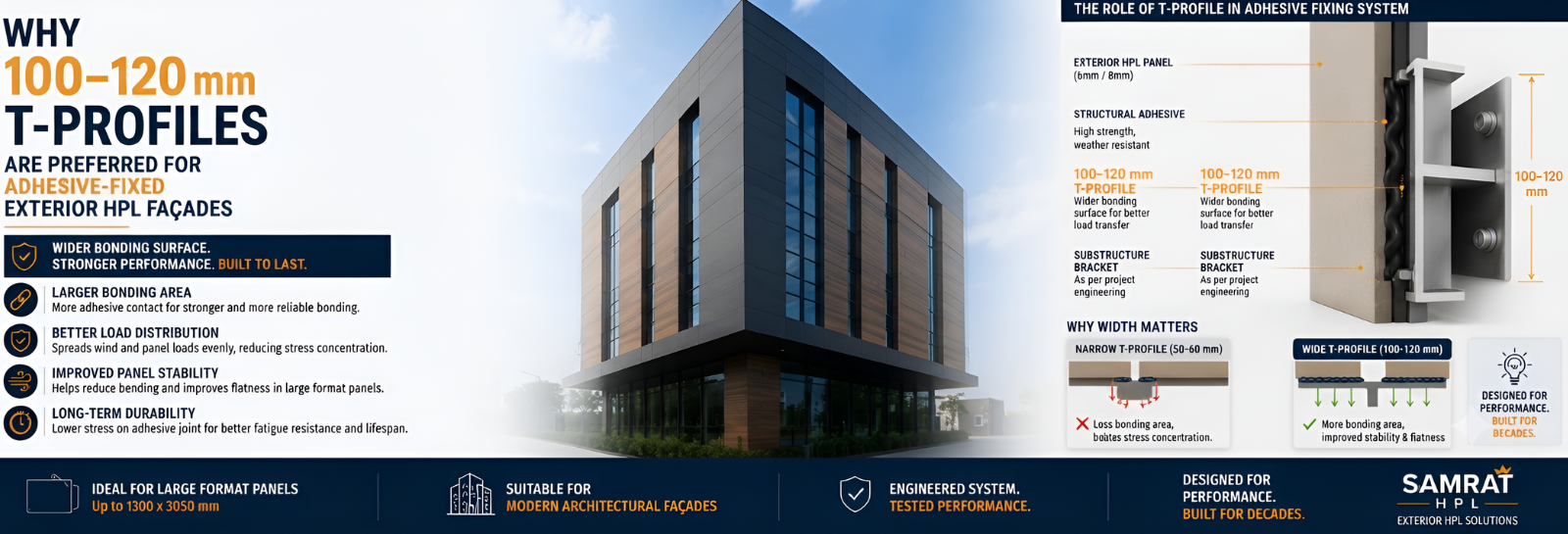
Why 100–120 mm Aluminium T-Profiles Are Preferred for Adhesive-Fixed Exterior HPL Façades
The Engineering Behind Stronger Bonding, Better Panel Stability and Long-Term Façade Performance
Modern architecture increasingly favours clean, uninterrupted façades without visible rivets or screws. As a result, adhesive-fixed Exterior HPL façade systems have become one of the fastest-growing installation methods for premium architectural projects.
Concealed fixing not only enhances aesthetics but also creates a sleek monolithic appearance that many architects prefer for commercial buildings, hospitals, educational institutions and luxury residences.
However, one question is often overlooked during façade design:
How wide should the aluminium T-profile be for an adhesive-fixed Exterior HPL system?
While many support profiles are available, experienced façade engineers increasingly recommend 100–120 mm aluminium T-profiles, especially for large-format Exterior HPL panels such as 1300 × 3050 mm.
The reason goes far beyond simply providing a larger support—it is fundamentally about engineering, structural load transfer, adhesive performance and long-term façade durability.
Why the Aluminium T-Profile Is Critical
Many people believe the adhesive alone holds the façade.
In reality, the aluminium T-profile, structural adhesive, primer and Exterior HPL panel work together as one engineered system.
The T-profile performs several essential functions:
- Supports the HPL panel.
- Transfers wind loads to the building structure.
- Provides the bonding surface for the adhesive.
- Maintains alignment and panel stability.
- Contributes to long-term façade performance.
Without a properly designed support profile, even the highest-quality structural adhesive cannot achieve its full potential.
Why Wider T-Profiles Improve Adhesive Performance
Structural adhesives develop their strength through bonded surface area.
The larger the effective bonding surface, the more evenly loads can be transferred between the panel and the aluminium substructure.
A 100–120 mm T-profile offers several advantages over narrower profiles:
- Larger adhesive contact area.
- More uniform stress distribution.
- Lower stress concentration.
- Improved bond durability.
- Better resistance to fatigue caused by thermal cycling.
Instead of concentrating loads along a narrow strip, the adhesive can distribute forces across a broader support surface.
Better Support for Large Exterior HPL Panels
Modern architecture increasingly uses large-format Exterior HPL panels, particularly 1300 × 3050 mm.
Larger panels naturally experience greater:
- Wind suction.
- Wind pressure.
- Thermal expansion.
- Self-weight.
- Dynamic movement.
A wider aluminium T-profile provides a broader support line, helping the bonded system transfer these forces more uniformly.
This contributes to improved overall façade stability.
Can Wider T-Profiles Reduce Panel Bending?
This is one of the most common questions asked by façade consultants.
The answer is:
Yes—but as part of the complete façade system.
A 100–120 mm T-profile cannot completely eliminate panel bending by itself.
However, it can significantly contribute to reducing localized out-of-plane movement because:
- The panel is bonded over a larger width.
- The adhesive experiences lower stress.
- Load transfer becomes more uniform.
- Local rotation of the panel is reduced.
- The bonded connection becomes stiffer.
For large-format panels such as 1300 × 3050 mm, these improvements help maintain better panel flatness throughout the façade.
Larger Bonding Width Means Lower Adhesive Stress
One of the fundamental principles of engineering is that increasing the area over which a force is distributed reduces the stress acting on that area.
When the adhesive is bonded to a wider aluminium profile:
- Shear stresses become more evenly distributed.
- Peel stresses at the bond edges are reduced.
- Localized stress concentrations decrease.
- Long-term fatigue resistance improves.
This is particularly important because façade systems undergo thousands of thermal expansion and contraction cycles during their service life.
Improved Wind Load Performance
Wind is one of the most demanding forces acting on an exterior façade.
Depending on building height and location, façade panels experience repeated:
- Positive pressure.
- Negative suction.
- Dynamic wind loading.
A wider T-profile provides a stronger and more stable bonded interface between the HPL panel and the supporting structure.
This contributes to better load distribution across the façade system.
➡️ Related Blog
Understanding Wind Loads in Exterior HPL Façades
Greater Installation Accuracy
Construction sites are rarely perfect.
A wider bonding profile provides installers with:
- Better adhesive placement.
- Easier alignment.
- Reduced installation errors.
- More consistent adhesive bead positioning.
These practical advantages improve installation quality across large projects.
Improved Long-Term Durability
Exterior façades are exposed every day to:
- UV radiation.
- Rain.
- Humidity.
- Freeze-thaw cycles.
- Building movement.
- Temperature fluctuations.
Because a wider bonding area reduces stress concentrations, the adhesive joint experiences lower fatigue over decades of service.
This contributes to a façade system that remains stable and reliable throughout its design life.
Is a Wider T-Profile Enough on Its Own?
No.
Panel flatness and long-term performance depend on the complete façade design.
A successful adhesive-fixed Exterior HPL system also requires:
- Proper panel thickness.
- Correct profile spacing.
- Approved structural adhesive.
- Compatible primer.
- Proper surface preparation.
- Controlled adhesive thickness.
- Correct expansion gaps.
- Adequate rear ventilation.
- Project-specific wind load calculations.
Each component contributes to the overall performance of the façade.
Why Samrat HPL Recommends Wider Support Profiles
At Samrat HPL, we have supplied Exterior Compact HPL for projects across more than 30 countries, representing over 9 million m² of installed façades.
Our experience with architects, façade consultants and installation partners has consistently shown that wider aluminium T-profiles provide significant engineering advantages for concealed adhesive systems—particularly when using large-format Exterior HPL panels.
Combined with correct adhesive selection, engineered substructures and proper installation practices, they contribute to façades that remain stable, aesthetically pleasing and durable for decades.
Continue Learning in the Samrat HPL Knowledge Centre
Explore these related technical guides:
Installation & Façade Engineering
- Exterior HPL Installation Guide
- Fixed Point & Sliding Point Explained
- Expansion Gaps in Exterior HPL
- Wind Load Design for Exterior HPL
- Ventilated Rainscreen Façades
Material Science
- Why High Pressure & High Temperature Matter
- Density of Exterior HPL
- PMMA Surface Protection
- Lifespan of Exterior HPL
- UV Resistance, Delta E & Grey Scale
Standards & Sustainability
- EN 438 Explained
- Fire Classification (B-s1,d0)
- NRO Certification for Poland
- REACH, VOC & E05 Explained
Frequently Asked Questions
Why are 100–120 mm T-profiles recommended for adhesive-fixed HPL façades?
They provide a larger bonding surface for structural adhesives, improving load distribution, reducing stress concentrations and supporting long-term façade performance.
Do wider T-profiles prevent HPL panels from bending?
They help improve panel stability and reduce localized out-of-plane movement, particularly with large-format panels. However, overall flatness also depends on panel thickness, profile spacing, adhesive quality, wind loads and installation.
Are concealed adhesive-fixed façades suitable for large HPL panels?
Yes. When engineered correctly with suitable aluminium profiles, structural adhesives and proper installation practices, concealed adhesive systems are widely used for large-format Exterior HPL façades.
What panel size benefits most from wider T-profiles?
Large panels, such as 1300 × 3050 mm, generally benefit the most because they experience higher wind loads, greater thermal movement and increased self-weight compared with smaller panels.
Conclusion
The performance of an adhesive-fixed Exterior HPL façade is determined by the strength of the complete system—not by the adhesive alone. A 100–120 mm aluminium T-profile provides a broader bonding surface that supports more uniform load transfer, improves resistance to localized deformation, enhances installation consistency and contributes to long-term façade durability. While profile width is only one element of successful façade engineering, it plays a significant role in helping large-format Exterior HPL panels perform reliably under the combined effects of wind, thermal movement and decades of environmental exposure.