


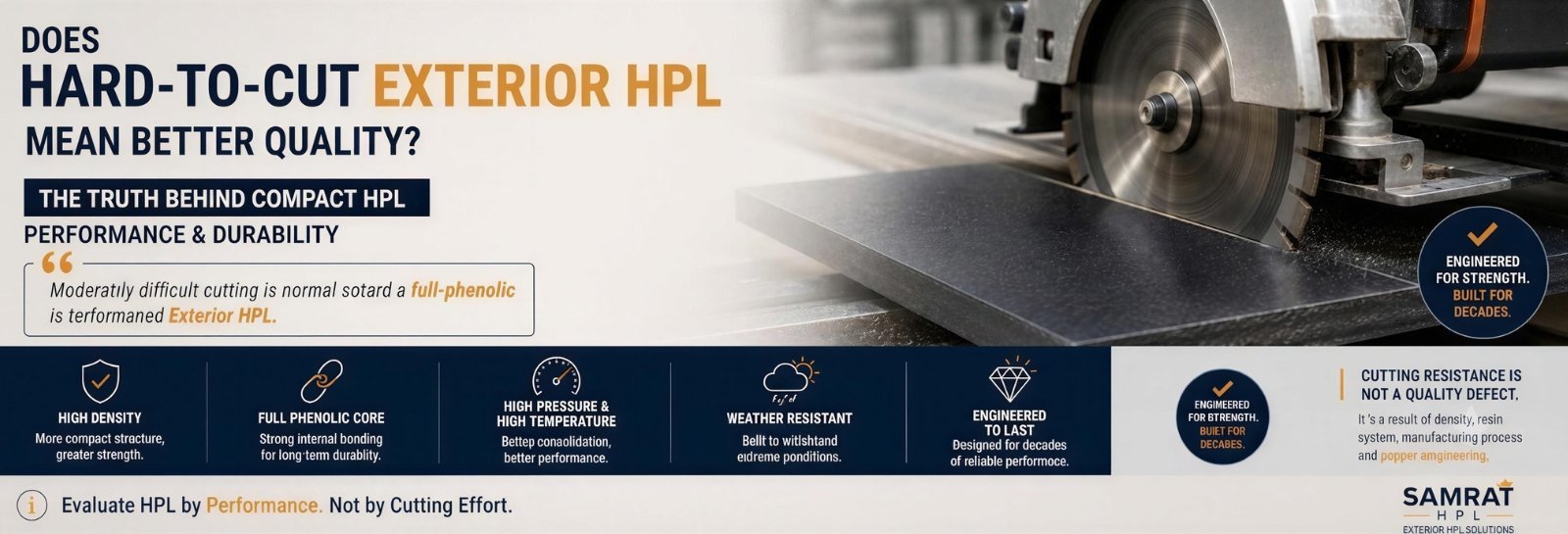
Does Hard-to-Cut Exterior HPL Mean Better Quality?
The Truth Behind Compact HPL Performance, Density and Machining
Among fabricators, installers and even some buyers, one statement is heard repeatedly:
“This Exterior HPL is very difficult to cut. It must be poor quality.”
Others believe exactly the opposite:
“If the panel is difficult to cut, it must be a high-quality HPL.”
Both assumptions are incomplete.
The truth is that cutting resistance alone is not an indicator of quality.
A properly manufactured Exterior Compact HPL is engineered to deliver structural strength, impact resistance, weather durability and long-term façade performance. These same characteristics naturally influence how the panel behaves during machining.
Rather than asking whether a panel is easy or difficult to cut, the better question is:
Does the panel achieve the engineering performance expected from a high-quality Exterior HPL?
At Samrat HPL, after supplying more than 9 million m² of Exterior Compact HPL across more than 30 countries, we have learned that understanding the science behind machining helps architects, façade consultants and fabricators make better decisions.
Why Exterior Compact HPL Is Naturally Harder Than Many Building Materials
Exterior Compact HPL is fundamentally different from materials such as plywood, MDF, PVC or ACP.
It is manufactured by compressing multiple layers of kraft paper impregnated with thermosetting phenolic resin under extremely high pressure and temperature.
The result is a dense, compact engineering material specifically designed to provide:
- High mechanical strength
- Excellent impact resistance
- Low water absorption
- Weather resistance
- Dimensional stability
- Long service life
These same characteristics make the material naturally more resistant to machining than softer construction products.
In other words, the properties that make Exterior HPL durable also influence the effort required to cut it.
Why Hard Cutting Is Not a Quality Defect
Many people mistakenly assume that if a saw works harder, something must be wrong with the panel.
From an engineering perspective, this conclusion is not correct.
A well-manufactured Exterior Compact HPL may require slightly greater cutting effort because of:
- Higher density
- Better fibre consolidation
- Fully cured phenolic resin
- Stronger internal bonding
- Uniform compact structure
These characteristics are generally associated with improved mechanical performance rather than poor quality.
However, this should not be confused with panels that are excessively difficult to machine because of manufacturing defects or unsuitable tooling.
The important distinction is that moderately higher cutting resistance is normal for a properly manufactured full-phenolic Exterior HPL.
What Actually Determines How Exterior HPL Cuts?
The machining behaviour of an HPL panel depends on many factors.
1. Density
Density is one of the biggest influences.
Higher-density panels contain more consolidated material, requiring more energy for the cutting tool to remove material.
This often results in:
- Better impact resistance
- Improved dimensional stability
- Stronger mechanical properties
➡️ Related Blog
Why Density Matters in Exterior HPL
2. High Pressure & High Temperature Manufacturing
Exterior HPL is produced under extremely high pressure and temperature.
These manufacturing conditions:
- Compress the kraft papers.
- Cure the thermosetting resin.
- Eliminate voids.
- Create a compact homogeneous core.
Better consolidation often results in a panel that machines differently from lower-density products.
➡️ Related Blog
Why High Pressure & High Temperature Matter in Exterior HPL
3. Full Phenolic Core Construction
Exterior Compact HPL manufactured with a full phenolic core behaves differently from products containing lower-density cores.
Fabricators frequently describe high-quality phenolic HPL as:
- Solid
- Dense
- Consistent
- Stable
These are characteristics of proper engineering rather than manufacturing defects.
4. Panel Thickness
A 6 mm Exterior HPL panel naturally requires less cutting effort than an 8 mm panel.
Thickness alone changes the machining characteristics.
Therefore, comparing different thicknesses based solely on cutting feel is misleading.
5. Cutting Equipment
The same panel can feel completely different depending on the equipment used.
Important factors include:
- Blade quality
- Tooth geometry
- Diamond vs carbide tooling
- Feed speed
- Cutting speed
- Machine rigidity
- CNC calibration
A properly manufactured panel can appear “hard to cut” simply because incorrect tooling is being used.
Can an HPL Panel Be Too Easy to Cut?
Surprisingly, yes.
If a Compact HPL panel machines unusually easily, it does not automatically indicate superior quality.
Depending on the reason, it may reflect:
- Lower density
- Reduced consolidation
- Different resin formulation
- Lower mechanical strength
This does not necessarily mean the product is poor—it simply means that cutting effort alone cannot be used to judge quality.
The Real Way to Judge Exterior HPL Quality
Professional façade consultants do not evaluate Exterior HPL by cutting feel.
Instead, they assess measurable engineering performance such as:
- EN 438 compliance
- Density
- Flexural strength
- Impact resistance
- Water absorption
- Dimensional stability
- UV resistance
- Fire classification
- Weather durability
These standardized properties provide objective evidence of product quality.
➡️ Related Blogs
- What is EN 438?
- Fire Classification Explained
- UV Resistance in Exterior HPL
- Lifespan of Exterior HPL
Why Proper Tooling Matters
Because Exterior Compact HPL is a high-density engineering material, it should always be machined using suitable equipment.
Professional fabricators generally recommend:
- Diamond-tipped saw blades
- High-quality carbide tooling
- Correct feed rates
- Appropriate spindle speeds
- Sharp, well-maintained blades
Using unsuitable blades increases cutting resistance, generates excess heat and may affect edge quality, regardless of the panel itself.
The Samrat HPL Perspective
At Samrat HPL, we manufacture Exterior Compact HPL with one objective—to deliver reliable long-term façade performance.
Our goal has never been to produce panels that are simply “easy to cut.”
Instead, we focus on achieving the engineering characteristics expected from a premium Exterior HPL:
- High density
- Controlled resin curing
- Consistent phenolic core
- Excellent dimensional stability
- Long-term weather resistance
- Reliable machining when appropriate tooling is used
This approach allows fabricators to achieve clean, accurate machining while providing architects with confidence in the long-term performance of the façade.
Myth vs Reality
| Myth | Reality |
|---|---|
| Hard-to-cut HPL means poor quality. | Cutting resistance alone is not a measure of HPL quality. |
| Easy-to-cut HPL is always better. | Cutting feel depends on density, resin system, tooling, and manufacturing process. |
| Cutting effort determines performance. | HPL performance is determined by engineering properties, testing, and compliance with industry standards. |
| Every Exterior HPL should machine identically. | Density, thickness, tooling, and production methods all influence machining behaviour. |
Continue Exploring the Samrat HPL Knowledge Centre
Material Science
- Why Density Matters in Exterior HPL
- High Pressure & High Temperature Explained
- PMMA Surface Protection
- UV Resistance & Delta E
Standards
- EN 438 Explained
- Fire Ratings (B-s1,d0)
- REACH, VOC & E05
Installation
- Exterior HPL Installation Guide
- Fixed Point & Sliding Point
- Expansion Gaps
- Wind Load Considerations
Buying Guides
- Why Exterior HPL Is the Preferred Façade Material for Modern Architecture
- Ultimate Buyer’s Guide to Exterior HPL
Frequently Asked Questions
Is it normal for Exterior HPL to be difficult to cut?
Yes. High-quality Exterior Compact HPL is manufactured to achieve high density and mechanical strength, which naturally makes it more resistant to machining than softer materials.
Does hard cutting mean better quality?
Not necessarily. Moderate cutting resistance is normal for a well-manufactured full-phenolic HPL, but quality should always be assessed using engineering standards such as EN 438 rather than cutting feel alone.
Why do different HPL panels cut differently?
Machining behaviour depends on density, resin formulation, panel thickness, manufacturing process and the cutting equipment being used.
What is the best way to cut Exterior HPL?
For clean edges and efficient machining, professional fabricators typically use diamond-tipped or high-quality carbide tools with the correct feed rates and spindle speeds.
Conclusion
One of the biggest misconceptions in the façade industry is that the ease or difficulty of cutting an Exterior HPL panel determines its quality. In reality, cutting behaviour is influenced by a combination of density, resin chemistry, manufacturing process, panel thickness and tooling. A properly manufactured full-phenolic Exterior Compact HPL will often require moderately greater cutting effort because it has been engineered for strength, durability and long-term façade performance—not for softness. The true measure of quality lies in verified engineering performance, compliance with recognized standards and consistent long-term behaviour in real-world applications.
[…] Related Guide → Does Hard-to-Cut Exterior HPL Mean Better Quality? […]