


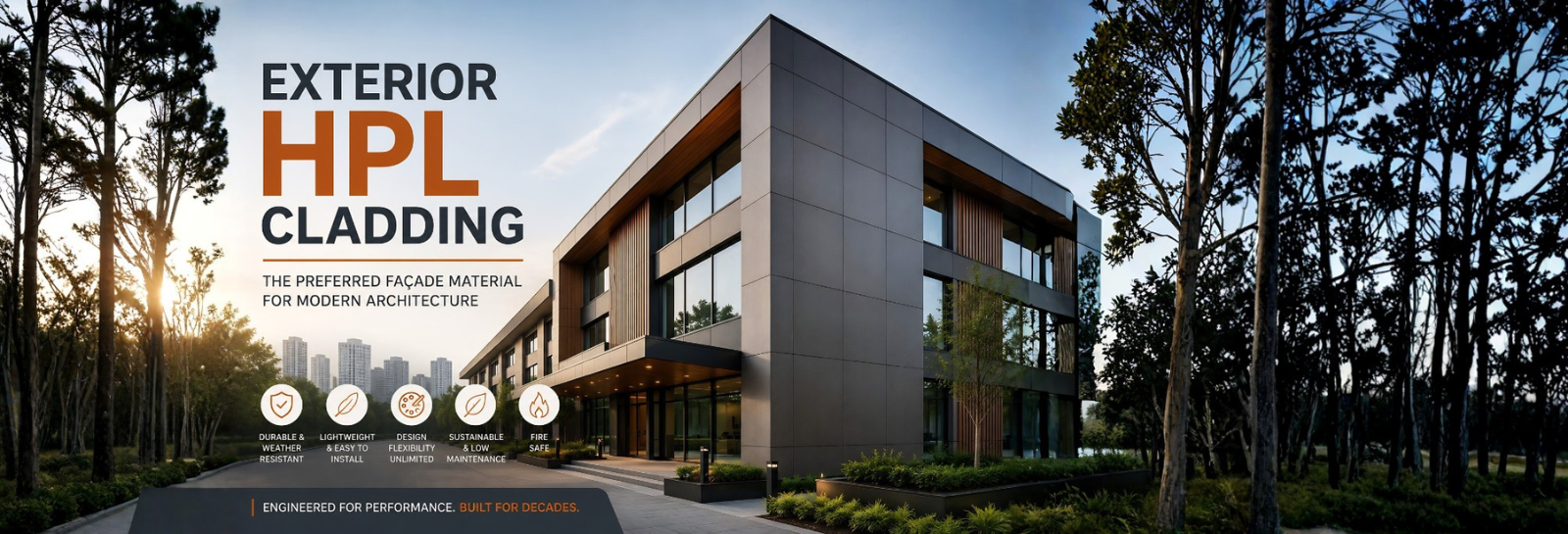
Why Exterior HPL Is the Preferred Façade Material for Modern Architecture
A Technical Comparison of Modern Façade Materials and Why Exterior Compact HPL Continues to Gain Preference Among Architects Worldwide
Modern architecture has evolved significantly over the last two decades.
Today’s buildings are expected to do much more than simply look attractive. Architects, developers and building owners now demand façade systems that combine aesthetics, durability, fire safety, sustainability, ease of installation and low life-cycle costs.
As a result, the choice of façade material has become one of the most important decisions during the design phase of any building.
Among the wide range of available façade materials—including ACP (Aluminium Composite Panels), Fibre Cement, Natural Stone, Ceramic Panels and GRC (Glass Fibre Reinforced Concrete)—Exterior Compact HPL (High Pressure Laminate) has emerged as one of the preferred solutions for contemporary architecture.
At Samrat HPL, our 100% dedicated focus on Exterior Compact HPL since 2008, combined with more than 9 million m² of successful global installations, has provided us with valuable insight into why architects increasingly specify Exterior HPL for projects across Europe, the Middle East, Asia and beyond.
This guide explains the engineering, architectural and commercial reasons behind that growing preference.
What Does Modern Architecture Expect from a Façade?
Before comparing materials, it is important to understand what today’s façade is expected to achieve.
A modern façade should provide:
- Long-term weather resistance
- Excellent UV colour stability
- Low maintenance requirements
- High impact resistance
- Reliable fire performance
- Lightweight construction
- Design flexibility
- Sustainable material choices
- Compatibility with ventilated rainscreen systems
- Long service life with predictable performance
No single material is perfect for every project. However, Exterior Compact HPL successfully combines many of these requirements into one integrated façade solution.
Comparing Today’s Most Popular Façade Materials
-
Exterior Compact HPL
Exterior Compact HPL is manufactured by compressing multiple layers of kraft paper impregnated with thermosetting phenolic resins under extremely high pressure and temperature. Decorative papers are permanently bonded beneath a weather-resistant protective surface, creating a dense and durable compact panel specifically engineered for exterior applications.
Ideal for
- Commercial buildings
- Educational institutions
- Hospitals
- Residential towers
- Corporate offices
- Public infrastructure
- Ventilated rainscreen façades
Key strengths
- Lightweight
- Excellent impact resistance
- Wide design flexibility
- Low maintenance
- UV-resistant finishes
- Suitable for rainscreen façades
Related Technical Guides
- What is EN 438?
- High Pressure & High Temperature in Exterior HPL
- Lifespan of Exterior HPL
- UV Stability & Delta E Explained
-
Aluminium Composite Panels (ACP)
ACP panels are widely used because they are lightweight and economical. They are suitable for many architectural applications and can offer a smooth, modern appearance.
However, when selecting ACP, designers often pay particular attention to:
- Fire classification
- Surface durability
- Dent resistance
- Long-term flatness
These considerations become increasingly important for projects requiring higher durability or demanding environmental exposure.
-
Fibre Cement Panels
Fibre Cement remains a respected façade material due to its non-combustible composition and architectural appearance.
It performs particularly well in applications where mineral-based materials are preferred.
However, architects should also consider:
- Higher panel weight
- Greater brittleness during handling
- More limited machining flexibility
- Increased transportation and installation effort
-
Natural Stone
Natural stone offers timeless aesthetics and exceptional prestige.
It remains an excellent solution for landmark buildings and luxury developments.
At the same time, it generally involves:
- Higher structural loading
- Longer installation times
- Greater transportation costs
- More complex support systems
-
Ceramic Façade Panels
Ceramic façades provide excellent colour permanence and weather resistance.
Their limitations are generally associated with:
- Brittle behaviour under impact
- Heavier support requirements
- Higher installation complexity
-
Glass Fibre Reinforced Concrete (GRC)
GRC allows the creation of complex architectural shapes and large decorative façade elements.
It is particularly suitable for custom moulded architectural features.
However, projects should also consider:
- Higher panel weight
- Larger supporting structures
- Increased installation requirements
Why Exterior HPL Fits Modern Architecture So Well
Rather than being the absolute best in every individual property, Exterior HPL stands out because it offers an exceptionally balanced combination of performance characteristics.
Design Freedom
One of the greatest advantages of Exterior HPL is its versatility.
Architects can specify:
- Solid colours
- Woodgrains
- Stone effects
- Metallic finishes
- Custom décors
while maintaining consistent panel performance.
Unlike many façade materials, HPL also allows precise CNC machining, routing and cutting, making it ideal for contemporary architectural expression.
Lightweight Construction
Compared with stone, ceramic and GRC, Exterior HPL is significantly lighter.
A lighter façade can contribute to:
- Reduced structural loads
- Easier handling
- Faster installation
- Lower transportation costs
These advantages become increasingly valuable on high-rise buildings and renovation projects.
High Impact Resistance
Modern buildings experience continuous mechanical exposure throughout their lifetime.
Exterior Compact HPL offers excellent resistance to everyday impacts, making it particularly suitable for:
- Schools
- Airports
- Railway stations
- Hospitals
- Public buildings
Related Blog: Density of Exterior HPL: Why It Matters for Strength, Impact Resistance & Durability
Engineered for Long-Term Weather Resistance
Unlike many building products designed primarily for interior use, Exterior Compact HPL is specifically engineered to withstand prolonged environmental exposure.
When manufactured according to EN 438 with appropriate resin systems and UV-protective surface technology, Exterior HPL offers excellent resistance to:
- Ultraviolet radiation
- Rain
- Humidity
- Temperature fluctuations
- Freeze–thaw cycles
Related Blogs
- Lifespan of Exterior HPL Cladding
- Organic vs Inorganic Pigments
- Delta E & Grey Scale Explained
- PMMA Protection in Exterior HPL
Compatible with Ventilated Rainscreen Systems
One of the major reasons architects specify Exterior HPL is its excellent compatibility with ventilated façade construction.
A properly designed rainscreen façade provides:
- Continuous rear ventilation
- Improved moisture management
- Enhanced thermal efficiency
- Longer service life of the building envelope
Exterior Compact HPL integrates naturally into these systems.
Low Maintenance Throughout Its Life
Modern building owners increasingly evaluate materials based on life-cycle cost, not simply purchase price.
Exterior HPL requires only routine cleaning using water and mild detergent under normal environmental conditions.
It does not generally require:
- Periodic repainting
- Surface sealing
- Protective coatings
This contributes to lower maintenance costs over the building’s lifespan.
Related Blog: Cleaning & Maintaining Exterior HPL Façades
The Samrat HPL Difference
Choosing Exterior HPL is only part of the decision. Choosing the right manufacturer is equally important.
At Samrat HPL, Exterior Compact HPL is not one product within a broad portfolio—it is our core expertise.
Our approach is built on:
- 100% dedicated focus on Exterior HPL since 2008
- More than 9 million m² installed globally
- Compliance with EN 438 performance requirements
- Fire-rated solutions including B-s1,d0 and NRO for Poland
- Advanced PMMA surface protection
- Controlled high-pressure manufacturing
- Technical support for architects, façade consultants and installers
- Dedicated European warehouse with approximately 80,000 m² of stock in 10 popular RAL colours, enabling faster delivery across the region
This focused philosophy allows us to optimise every stage—from resin chemistry and manufacturing to installation guidance and long-term façade performance.
Which Façade Material Is Right for Your Project?
Every project has different priorities.
Natural stone may be selected for prestige. Ceramic may suit specific architectural concepts. Fibre Cement and GRC each have applications where they perform well.
However, when a project requires a combination of:
- Modern aesthetics
- Lightweight construction
- Design flexibility
- Long-term durability
- Low maintenance
- Fire-tested solutions
- Ventilated façade compatibility
- Sustainable engineering
Exterior Compact HPL offers one of the most balanced solutions available in today’s market.
Continue Learning in the Samrat HPL Technical Knowledge Centre
Explore these detailed guides before finalising your façade specification:
Product Standards
- EN 438 Explained
- High Pressure & High Temperature
- Density of Exterior HPL
Fire Safety
- B-s1,d0 Fire Classification
- NRO Certification for Poland
Durability
- Lifespan of Exterior HPL
- UV Resistance & Delta E
- PMMA Surface Protection
Installation
- Expansion Gaps
- Fixed Point & Sliding Point
- Exterior HPL Installation Guide
- Wind Load Performance
Sustainability
- REACH, VOC & E05 Explained
Frequently Asked Questions
Is Exterior HPL suitable for modern architecture?
Yes. Exterior Compact HPL combines aesthetics, durability, lightweight construction and compatibility with ventilated façade systems, making it well suited to contemporary architectural design.
Why do architects choose Exterior HPL over traditional façade materials?
Many architects value its balance of design flexibility, weather resistance, low maintenance, and ease of installation while also meeting technical performance requirements.
Can Exterior HPL be used in high-rise buildings?
Yes. When properly engineered and installed, Exterior HPL is widely used in commercial buildings, educational facilities, healthcare projects, and residential towers.
Final Positioning
Modern architecture demands more than attractive façades—it demands materials that deliver predictable performance over decades. Exterior Compact HPL has become a preferred choice because it combines engineering performance, design flexibility, durability, and efficient installation within a single façade solution. At Samrat HPL, our exclusive focus on Exterior HPL since 2008, supported by global project experience and a commitment to technical excellence, enables us to help architects and developers specify façades with confidence—not just for today, but for the entire life of the building.