


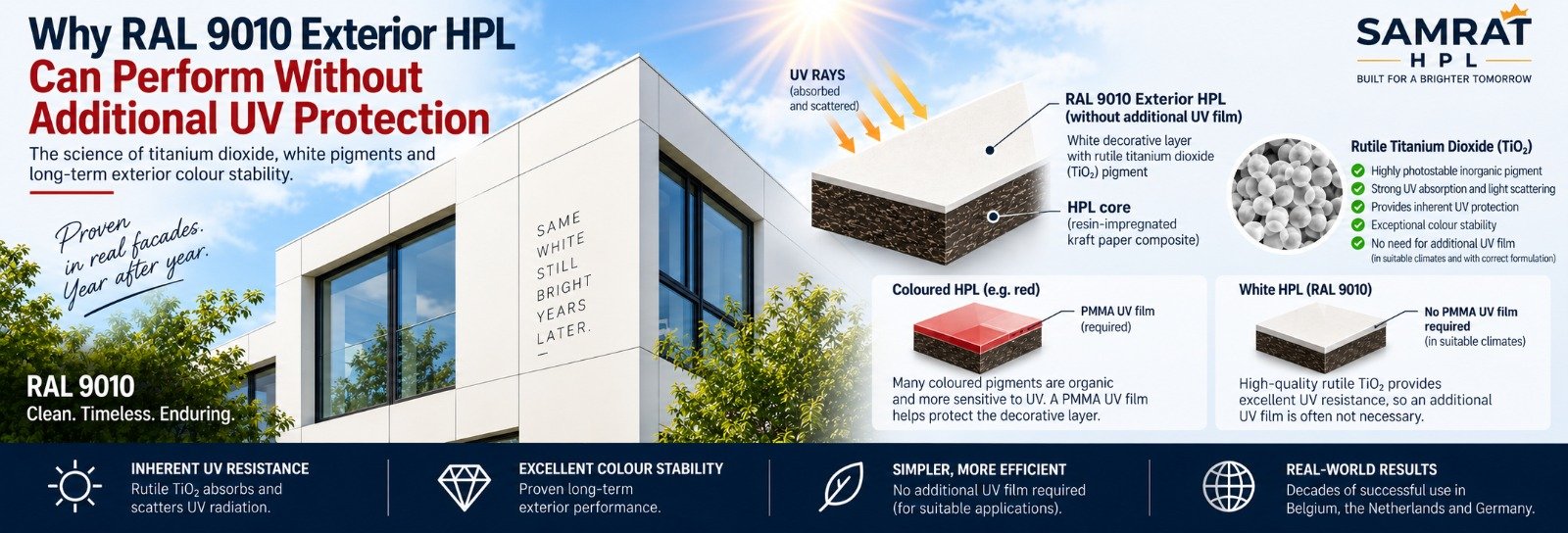
Why RAL 9010 Exterior HPL Can Perform Without Additional UV Protection?
Why White HPL Can Maintain Exceptional Colour Stability—and Why Some European Exterior HPL Applications May Not Require the Same UV Surface Protection as Other Colours
Walk past an older building clad in white Exterior HPL in the Netherlands, Belgium or Germany and you may notice something interesting.
After years of exposure to sunlight, rain, temperature changes and seasonal weather, the white façade can still look remarkably close to its original colour.
This raises an obvious question:
Why does white Exterior HPL resist fading so well when UV protection is such an important subject for coloured HPL panels?
The answer lies largely in the pigment responsible for creating the white colour:
Titanium dioxide — TiO₂.
High-quality white decorative papers typically rely heavily on titanium dioxide for opacity and whiteness. For exterior applications, the characteristics and treatment of this pigment can have a major influence on long-term performance.
And this makes RAL 9010 white Exterior HPL scientifically quite different from many reds, yellows, oranges, blues and other chromatic colours.
Let’s understand why.
First: What Actually Causes an HPL Colour to Fade?
Sunlight contains ultraviolet radiation.
Over years of exterior exposure, UV radiation can initiate photochemical reactions in susceptible components of a decorative surface.
For many colours, the appearance comes from organic or mixed pigment systems.
Organic pigments contain specific molecular structures responsible for selective absorption of visible wavelengths—which is what creates the colour we see.
Prolonged exposure to UV radiation can, depending on the pigment chemistry, gradually alter these molecular structures.
The result may eventually become visible as:
- Colour fading
- Hue change
- Loss of saturation
- Uneven weathering
- Differences between exposed and protected areas
This is one reason why pigment selection is fundamental to Exterior HPL engineering.
Related Blog
Organic vs Inorganic Pigments in Exterior HPL: UV Stability & Long-Term Colour Performance
Why Is White Different?
White is fundamentally different from most chromatic colours.
A high-quality exterior white decorative paper commonly uses rutile titanium dioxide (TiO₂) as its principal white pigment.
Titanium dioxide is an inorganic mineral pigment.
It is valued for properties including:
- Exceptional whiteness
- High opacity
- Strong light scattering
- Excellent hiding power
- High photostability
- Strong resistance to colour change
Unlike many organic colourants, TiO₂ does not depend on a complex organic molecular colour system that is susceptible to the same types of photochemical degradation.
That gives high-quality white pigmentation an important inherent advantage:
The pigment responsible for producing the white appearance is itself exceptionally resistant to light-induced colour change.
This is one of the major reasons properly engineered white Exterior HPL can demonstrate outstanding long-term colour stability.
Titanium Dioxide Doesn’t Just Make HPL White
This is where the science becomes particularly interesting.
TiO₂ is not simply a white colouring agent.
It also interacts strongly with ultraviolet radiation.
Rutile TiO₂ has a band gap of approximately 3.0 eV, corresponding broadly to wavelengths around 410 nm, although practical UV attenuation depends on particle size, coatings and formulation.
In simple terms, TiO₂ can strongly attenuate portions of UV radiation while also scattering visible light very effectively.
So when sufficient high-quality TiO₂ is incorporated into a white decorative layer, the pigment can perform two important jobs:
Job 1 — Create Whiteness
It scatters visible light extremely effectively, giving the surface its opaque white appearance.
Job 2 — Contribute to UV Protection
It can reduce penetration of UV radiation deeper into the decorative/resin system.
This means a properly formulated white surface possesses a degree of inherent UV robustness that many chromatic pigment systems do not naturally have.
So Is White HPL Its Own UV Protection?
Partially—but this needs careful wording.
It would be incorrect to say that titanium dioxide makes a UV-protective surface film unnecessary in every white Exterior HPL application.
What we can say is:
A properly formulated white decorative surface containing high-quality exterior-grade rutile TiO₂ can inherently provide substantially better colour stability and UV attenuation than many chromatic colour systems.
That distinction matters.
A dedicated exterior surface such as PMMA provides broader protection to the decorative system and should not be viewed as chemically identical to TiO₂ pigmentation.
But in appropriate white-only applications, particularly where long-term field experience supports the construction, the inherent stability of the white pigment system can influence the UV-protection strategy.
Not All Titanium Dioxide Is the Same
This may be the most important part of the entire article.
Simply saying:
“Our white contains titanium dioxide.”
is not enough.
There are different TiO₂ crystal forms, particle characteristics and surface treatments.
For durable exterior applications, rutile TiO₂ is generally preferred over anatase because of its superior weathering characteristics.
But even within rutile pigments, quality varies.
And there is another issue that must be controlled:
Photocatalytic activity.
The TiO₂ Paradox: UV Protection vs Photocatalytic Activity
Titanium dioxide interacts with UV radiation—which is useful.
But unmodified TiO₂ can also exhibit photocatalytic activity.
Under UV exposure, reactive species can be generated at the pigment surface.
If this activity is not properly controlled, it can contribute to degradation of the surrounding organic binder or resin system.
One possible long-term manifestation is:
Chalking.
Chalking is different from fading.
Instead of simply changing colour, the surface can develop a fine powdery appearance as the surrounding organic material gradually degrades.
So good exterior pigment engineering is not simply:
“Use more titanium dioxide.”
It is:
Use the correct titanium dioxide grade, particle characteristics, surface treatment and formulation for the exterior application.
Why Surface-Treated Rutile TiO₂ Matters
High-performance exterior-grade TiO₂ pigments are commonly surface-treated with inorganic coatings such as silica and/or alumina.
These treatments help control the interaction between the TiO₂ particle and the surrounding resin system.
The objective is to retain desirable properties such as:
- Whiteness
- Opacity
- Light scattering
- UV attenuation
while reducing undesirable photocatalytic activity.
This is why two white HPL panels that both visually match RAL 9010 when new may not necessarily have identical long-term exterior performance.
The colour code tells you the colour.
It does not tell you the pigment engineering behind the colour.
That distinction is extremely important for architects and buyers.
RAL 9010 Is a Colour Specification—not a Durability Specification
This deserves particular emphasis.
RAL 9010 defines a colour appearance.
It does not, by itself, specify:
- Titanium dioxide grade
- Pigment loading
- Pigment surface treatment
- Decorative paper construction
- Resin formulation
- UV resistance
- Exterior weathering performance
- Xenon Arc performance
Two manufacturers can therefore supply panels that both appear to be RAL 9010.
On Day 1, they may look nearly identical.
But their material formulations can be completely different.
That is why Exterior HPL should never be evaluated purely by matching the RAL code.
Why Can RAL 9010 Perform So Well in Northern Europe?
Markets such as the Netherlands, Belgium and Germany provide an interesting real-world environment for white Exterior HPL.
There are three major reasons why stable white systems can perform particularly well there.
1. Excellent Inherent Stability of White Pigmentation
A high-quality rutile TiO₂ system begins with very strong resistance to colour change.
2. Lower Solar UV Dose Than More Extreme Climates
Northern and Western European climates generally experience lower annual solar irradiation than regions such as:
- Southern Europe
- Middle East
- North Africa
- Parts of Asia
This matters because exterior ageing is cumulative.
The amount of radiation a façade receives over 10 or 20 years influences the total photochemical stress placed on the surface.
3. Long-Term Field Experience
When a particular white HPL construction has performed successfully in the same climate for many years, that field history becomes valuable evidence.
Laboratory testing is important.
But real façades provide another level of information:
How does the material actually behave after years of rain, UV exposure, temperature cycling and seasonal weather?
Does This Mean RAL 9010 Doesn’t Need PMMA?
Not universally.
And this is where Exterior HPL manufacturers and specifiers need to be technically responsible.
The question should not be:
“Does white need PMMA—yes or no?”
The better question is:
“Does this particular white surface construction provide sufficient verified weathering performance for this particular climate and application?”
For a proven RAL 9010 product in the Netherlands, for example, a non-PMMA construction may be technically appropriate when supported by relevant testing and long-term field experience.
But the same decision should not automatically be copied for:
- Dubai
- Israel
- Saudi Arabia
- India
- Southern Spain
- Other high-UV environments
The pigment science remains the same.
The environmental UV dose does not.
Why Do Other HPL Colours Benefit More from UV Protection?
Now compare white with a bright red.
The red surface may depend significantly on organic pigment chemistry.
Those pigments can provide:
- Strong colour
- Excellent brightness
- Architectural flexibility
but may also have greater sensitivity to prolonged UV exposure than high-quality rutile TiO₂.
A dedicated UV-protective layer such as PMMA can therefore play a particularly important role.
At Samrat Exterior HPL, our UV-protected Exterior HPL systems use high-performance surface technology designed to reduce the amount of damaging radiation reaching the decorative layer.
This becomes particularly valuable for:
- Reds
- Oranges
- Yellows
- Blues
- Bright architectural colours
- Wood decors
- Stone decors
Related Blog
PMMA Exterior HPL: How UV Surface Protection Works
White HPL vs Coloured HPL: A Simple Comparison
This is why one UV strategy should not automatically be applied to every Exterior HPL colour.
Good façade engineering recognises that different colours can require different solutions.
Fading and Chalking Are Not the Same Thing
Buyers should understand this distinction.
Fading
The colour itself changes.
For example:
Bright red → lighter red
Chalking
The surface develops a powdery residue or degraded appearance while the underlying colour may remain relatively white.
This means evaluating an old white façade only by asking:
“Is it still white?”
does not tell the whole story.
Also examine:
- Surface texture
- Gloss retention
- Chalking
- Uniformity
- Resin condition
Long-term exterior performance involves more than Delta E alone.
What Should an Architect or Buyer Ask About White Exterior HPL?
If you are specifying RAL 9010 or another white Exterior HPL, ask the manufacturer:
1. What pigment system is used?
Look beyond the RAL number.
2. Is exterior-grade rutile titanium dioxide used?
This is more relevant than simply asking whether TiO₂ is present.
3. Is the TiO₂ surface treated?
Exterior durability depends heavily on pigment engineering.
4. What accelerated weathering data is available?
Ask about Xenon Arc or equivalent exterior weathering evaluation.
5. Is the product being supplied with or without additional UV protection?
Understand the construction.
6. In which climates has that exact construction been used?
Field performance matters.
7. How old are the reference façades?
A five-month-old project proves very little about long-term UV durability.
A ten- or fifteen-year-old façade tells you considerably more.
Laboratory Testing + Real Façades = Better Evidence
At Samrat, we believe Exterior HPL weathering should not be understood from a single number.
Accelerated laboratory testing can measure:
- Colour change
- Grey Scale
- Delta E
- Surface deterioration
- Weathering behaviour
But real-world installations provide another layer of evidence.
A good Exterior HPL evaluation should therefore combine:
Material science + laboratory testing + climate-specific field experience
This is especially important when deciding whether a particular white construction requires additional UV surface protection.
The Samrat Exterior HPL Approach
At Samrat Exterior HPL, colour selection is treated as an engineering decision—not simply a printing decision.
Our exterior decorative systems are selected considering:
- Pigment chemistry
- Decorative paper quality
- Colour family
- UV exposure
- Surface technology
- Climate
- Laboratory weathering
- Long-term façade performance
For coloured Exterior HPL, our PMMA-based UV protection provides an additional protective barrier designed for demanding exterior exposure.
For white systems such as RAL 9010, the naturally strong weathering characteristics of properly engineered TiO₂ pigmentation create a different technical situation.
This is why the correct Exterior HPL question is rarely:
“Which technology is best for every colour?”
It is:
“Which combination of pigment, decorative paper, UV technology and surface construction is appropriate for this colour and this climate?”
That is the difference between simply manufacturing a coloured laminate and engineering an Exterior HPL façade panel.
Frequently Asked Questions
Why does white Exterior HPL fade less than other colours?
High-quality white surfaces generally use rutile titanium dioxide, an inorganic pigment with excellent photostability, opacity and UV attenuation. Many chromatic colours rely partly or entirely on pigment chemistries that can be more sensitive to long-term UV exposure.
Does RAL 9010 never fade?
No exterior material should be described as literally incapable of colour change. However, properly formulated RAL 9010 using high-quality exterior-grade TiO₂ can provide exceptionally high colour stability.
Does titanium dioxide absorb UV?
TiO₂ interacts strongly with UV radiation and can significantly attenuate UV penetration while also providing excellent visible-light scattering.
Why is rutile TiO₂ preferred for exterior applications?
Rutile generally offers better durability and weathering performance than anatase for conventional exterior pigment applications, particularly when appropriately surface treated.
Why is TiO₂ surface treated?
Surface treatments such as silica and alumina can help suppress undesirable photocatalytic activity while maintaining the pigment’s optical and weathering properties.
Can white Exterior HPL be manufactured without PMMA?
Yes, some white exterior constructions can be engineered without the same additional UV surface used for more UV-sensitive colours. However, the decision should be supported by pigment quality, product testing, field experience and climate-specific considerations.
Why might a non-PMMA white work in the Netherlands but require reconsideration in the Middle East?
Because cumulative UV and solar exposure can differ substantially between climates. A construction proven in Northern Europe should therefore be evaluated before assuming identical performance in a substantially higher-irradiance region.
What is the difference between fading and chalking?
Fading is a change in colour. Chalking is surface degradation that creates a powdery appearance. A white panel can show little colour change but still exhibit chalking if its pigment/resin system is unsuitable.
The Bottom Line: White Is More Than Just Another HPL Colour
The exceptional colour stability of white Exterior HPL is not a coincidence.
It begins with materials science.
High-quality rutile titanium dioxide provides:
Whiteness + opacity + light scattering + photostability + UV attenuation.
When the TiO₂ is appropriately surface treated and incorporated into a properly engineered exterior decorative system, the result can be exceptional long-term colour stability.
That helps explain why white Exterior HPL façades—particularly RAL 9010 in Northern European markets such as the Netherlands, Belgium and Germany—can maintain their appearance remarkably well over long periods.
But there is an equally important lesson:
RAL 9010 is only a colour code. It is the pigment engineering behind RAL 9010 that determines its long-term exterior performance.
And climate still matters.
The correct approach is therefore not to assume that white always needs PMMA—or that white never needs PMMA.
It is to understand the pigment, surface construction, test evidence, climate and real-world performance behind the panel.
That is how Exterior HPL should be specified.