


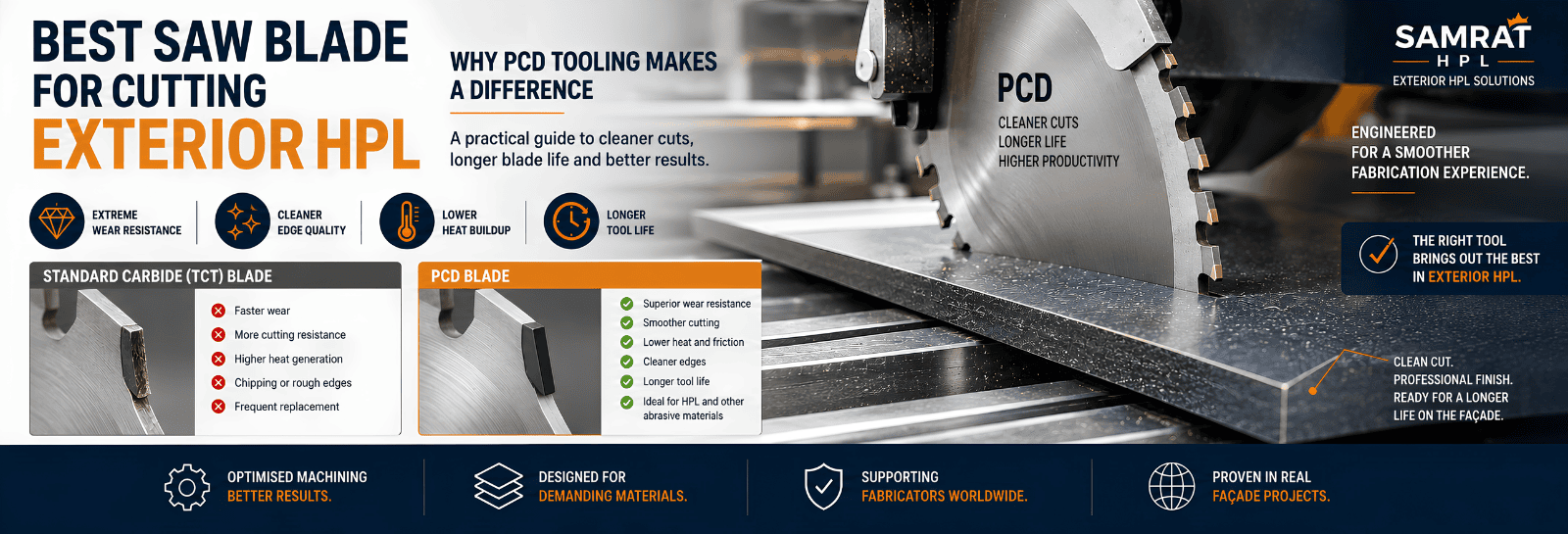
Best Saw Blade for Cutting Exterior HPL: Why PCD Tooling Makes a Difference
A Practical Guide to Cutting Compact HPL, Reducing Blade Wear, Chipping and Cutting Resistance
There is a familiar conversation in the Exterior HPL industry.
A fabricator or installer starts cutting a new batch of 6 mm or 8 mm Exterior Compact HPL and says:
“This HPL is very hard to cut. Our blade is becoming blunt too quickly.”
The immediate reaction is sometimes to question the panel.
But before questioning the HPL, there is another question that should be asked:
What blade are you using — and what tool are you cutting it with?
Exterior Compact HPL is a dense, resin-impregnated thermoset composite. It is intentionally engineered to resist impact, moisture, weathering and years of exterior exposure.
Those same characteristics also mean HPL is inherently demanding on cutting tools.
In many cases, what appears to be a “hard-to-cut HPL problem” is actually a tooling-material mismatch — and this often becomes most obvious not in a factory environment, but during installation on site.
This is precisely where PCD — Polycrystalline Diamond — tooling becomes important.
Why Is Compact HPL Difficult to Cut?
To understand the blade problem, first understand the material.
Exterior Compact HPL consists of multiple layers of kraft paper impregnated with thermosetting phenolic resin and consolidated under high pressure and temperature.
After curing, those individual layers become a dense compact composite.
That gives Exterior HPL important properties such as:
- High density
- High mechanical strength
- Excellent impact resistance
- Strong internal bonding
- Moisture resistance
- Dimensional stability
- Long-term durability
But a material engineered to withstand decades on a building is naturally very different to machine from MDF, plywood or ordinary timber.
Durability and machinability are two different requirements.
A panel should therefore not be judged as poor quality simply because it requires appropriate professional tooling.
Related Guide → Does Hard-to-Cut Exterior HPL Mean Better Quality?
Why Does HPL Wear Saw Blades Faster?
Every time a saw tooth enters Compact HPL, its cutting edge must repeatedly machine a dense combination of cured thermoset resin and cellulose reinforcement.
That continuous interaction creates abrasive wear at the cutting edge.
As the cutting edge progressively loses sharpness:
Blade wear increases → cutting resistance increases → heat increases → edge quality deteriorates.
Eventually, the operator experiences the panel as being considerably more difficult to cut.
And this is where an interesting misunderstanding begins.
The material has not suddenly become harder.
The cutting edge has become less effective.
The Dull-Blade Effect: Why HPL Suddenly Feels “Too Hard”
Imagine cutting the first few panels with a sharp blade.
Everything appears normal.
After repeated cutting, however, the blade begins losing its cutting edge.
The operator may notice:
- Greater cutting resistance
- More machine load
- Slower cutting
- Rougher edges
- Increased chipping
- Higher cutting temperature
- Burning or darkening along the cut
- Increased noise or vibration
The natural conclusion can be:
“Something is wrong with this batch of HPL.”
But replacing the worn blade with suitable sharp tooling can completely change the cutting experience.
This is why blade condition should always be checked before diagnosing an HPL material problem.
TCT vs PCD: What’s the Difference?
TCT — Tungsten Carbide Tipped
TCT blades are widely used throughout woodworking.
They can successfully machine many materials and can also cut HPL when correctly specified.
However, Compact HPL is significantly more demanding than ordinary timber-based products.
With continuous production cutting, carbide cutting edges can wear progressively, requiring:
- More frequent sharpening
- More frequent blade replacement
- Increased machine load
- Greater risk of declining edge quality
For occasional cutting or limited fabrication, good-quality carbide tooling can still perform very well.
PCD — Polycrystalline Diamond
PCD tooling uses a polycrystalline diamond cutting material bonded to a supporting substrate.
Diamond’s exceptional hardness and wear resistance make PCD particularly suited to abrasive engineered panel materials.
For high-volume HPL fabrication, this can provide substantially longer useful tool life than conventional carbide tooling.
The exact improvement depends on:
- Blade design
- Machine type
- HPL thickness
- Feed rate
- RPM
- Tooth geometry
- Production conditions
But the engineering principle is straightforward:
For repetitive machining of abrasive Compact HPL, PCD tooling can provide significantly greater wear resistance and longer cutting-edge life.
Why PCD Works So Well with Exterior HPL
1. Much Higher Wear Resistance
This is the primary advantage.
The cutting edge remains effective for substantially longer during repetitive HPL machining.
That means:
- Less frequent blade replacement
- Fewer sharpening interruptions
- More consistent cutting
- Better production efficiency
For someone cutting occasional panels, this may be less important.
For a fabricator cutting hundreds or thousands of panels, it becomes extremely important.
2. More Consistent Edge Quality
A sharp cutting edge produces a cleaner cut.
As tooling wears, edge quality deteriorates.
Properly specified PCD tooling helps maintain more consistent:
- Edge finish
- Cutting accuracy
- Surface quality
- Production repeatability
This is particularly valuable for façade panels where exposed edges remain visible after installation.
3. Lower Cutting Resistance as the Tool Stays Sharp
This is directly connected to the complaint:
“Your HPL is hard to cut.”
Sometimes the correct response is not to modify the HPL.
It is to improve the tooling.
When a suitable cutting edge remains sharp, the saw can machine the panel more efficiently and consistently.
4. Reduced Heat Generation from Worn Tooling
A worn blade creates greater friction.
Greater friction generates more heat.
Excessive heat can contribute to:
- Poor edge quality
- Burning
- Cutting inaccuracies
- Accelerated tool wear
Keeping the cutting edge sharp therefore helps maintain a more controlled machining process.
Is PCD Mandatory for Cutting Exterior HPL?
No — and this distinction is important.
Exterior Compact HPL can be cut with correctly specified high-quality carbide tooling.
For:
- Occasional cutting
- Small quantities
- Site adjustments
a suitable carbide blade may perform perfectly well.
However, for:
- Continuous production
- Large quantities
- CNC machining
- Panel-sizing operations
- Industrial façade fabrication
PCD tooling can become the more economical solution because of its superior wear resistance.
The more HPL you process, the stronger the economic case for PCD becomes.
Cutting Exterior HPL On-Site: What Installers Need to Know
This is where many real-world complaints originate.
On-site installers are rarely working with a calibrated beam saw.
They may be using:
- Handheld circular saws
- Track saws
- Jigsaws
- Portable cutting tools
often under time pressure and sometimes with a general-purpose blade that was never designed for Compact HPL.
That changes the entire cutting environment.
A beam saw provides:
- Stable RPM
- Full panel support
- Controlled feed
- Accurate alignment
- Consistent cutting geometry
A handheld tool relies much more heavily on:
- Operator pressure
- Panel support
- Blade condition
- Tool rigidity
- Cutting technique
This is why tooling choice becomes especially important on site.
Practical Advice for Site Cutting
Use a Blade Designed for Laminate or Compact HPL
Do not assume a general wood-cutting blade is suitable.
A fine-tooth carbide or PCD blade designed for laminate or Compact HPL will usually provide far better:
- Cutting resistance
- Edge quality
- Blade life
- Control
Use a Track Saw Where Possible
A track saw offers a guided, straight cut with less side-load on the blade.
That can reduce:
- Binding
- Chipping
- Wandering
- Operator fatigue
For repeated façade installation work, this can make a major difference.
Support the Panel Properly
An unsupported panel can flex slightly during cutting.
That can increase resistance and affect edge quality.
This is especially relevant for 6 mm Exterior Compact HPL, where correct support along the cut line helps maintain stability.
Orient the Decorative Face Correctly
Chip-out often occurs on the side where the blade exits the material.
Therefore, face orientation should match the cutting tool and cutting direction.
For handheld tools, always follow the tool manufacturer’s recommended panel orientation and make a trial cut before processing production panels.
Do Not Force a Dull Blade
This is one of the most common mistakes.
A blade that has already lost its edge:
- Cuts slower
- Generates more heat
- Produces more vibration
- Increases chipping
- Makes the HPL feel “too hard”
Replacing a worn blade often improves the cutting experience immediately.
Keep the Blade Clean
Resin buildup on cutting teeth can reduce effective sharpness even before the cutting material itself has fully worn.
Regular blade cleaning can help maintain more consistent performance.
The Core Message for Installers
A beam-saw-quality cut may not always be required on site.
But a purpose-built blade is.
Using the right laminate-rated carbide or PCD blade on a properly supported panel resolves a large percentage of on-site cutting complaints without changing anything in the HPL itself.
Don’t Select a Blade Only by Tooth Count
Another common mistake is asking:
“How many teeth should my HPL blade have?”
Tooth count matters, but it is only one variable.
Correct tooling selection also depends on:
- Blade diameter
- Machine type
- Spindle speed
- Feed speed
- Panel thickness
- Cutting direction
- Tooth geometry
- Hook angle
- Blade kerf
- Scoring arrangement
- Required edge quality
There is no single universal blade specification suitable for every machine.
The better approach is to tell your tooling supplier:
- You are machining Compact HPL
- The panel thickness
- The machine type
- Blade diameter
- RPM
- Required cutting quality
- Expected production volume
and allow the blade to be configured accordingly.
What About Feed Speed and RPM?
Another widespread misconception is:
“HPL is hard, so simply run the saw slower.”
Not necessarily.
Cutting parameters need to work together.
An excessively aggressive feed can overload the cutting edge.
But an unnecessarily slow feed can also increase rubbing and heat generation.
The correct balance depends on:
Tool diameter + number of teeth + RPM + feed rate + material thickness + tooth geometry
This is why professional tooling manufacturers provide machining parameters for specific blade and machine combinations.
Why Is My HPL Chipping During Cutting?
Chipping does not automatically mean poor HPL quality.
Before blaming the panel, check:
- Is the blade sharp?
- Is the blade designed for Compact HPL?
- Is the tooth geometry appropriate?
- Is the feed rate correct?
- Is the saw properly aligned?
- Is vibration present?
- Is the panel adequately supported?
- Is a scoring blade required?
- Is blade projection correct?
Often, changing one of these parameters dramatically improves edge quality.
What Is a Scoring Blade and Why Can It Help?
On professional panel-sizing equipment, a scoring blade or pre-cutter may be used ahead of the main blade.
Its purpose is to make a shallow preliminary cut before the main saw blade passes through the panel.
This can help reduce chip-out on the opposite face.
If bottom-side chipping persists despite a sharp main blade and correct machine settings, it is worth discussing scoring arrangements with the tooling supplier.
What About 6 mm Exterior HPL?
Thin façade panels require particular attention during machining.
A 6 mm Exterior Compact HPL panel is rigid for its thickness, but inadequate support or machine vibration can still affect cutting quality.
Ensure:
- Proper panel support
- Stable machine setup
- Correct blade alignment
- Sharp tooling
- Suitable cutting parameters
This becomes particularly important when processing full-size panels such as 1300 × 3050 mm.
Recycled Kraft vs Virgin Kraft: Does It Affect Cutting?
This question deserves a careful answer.
The raw-material characteristics of kraft paper can influence the behaviour of the final composite.
However, it would be an oversimplification to say:
“Recycled kraft HPL is always harder to cut.”
Exterior HPL machining behaviour depends on the complete panel construction, including:
- Kraft characteristics
- Resin impregnation
- Resin system
- Density
- Degree of consolidation
- Curing
- Panel thickness
- Tooling
Raw-material variability may contribute to differences in machining behaviour, but cutting resistance should be evaluated through the complete material-tooling system, rather than attributed to one raw material alone.
That is the technically stronger position.
A Simple Diagnostic Before Blaming the HPL
When a fabricator or installer reports:
“This HPL is too hard to cut.”
Use this sequence:
Step 1 — Inspect the blade.
Is it worn, chipped, dirty or incorrectly sharpened?
Step 2 — Install a fresh purpose-built blade.
Does cutting resistance improve?
Step 3 — Confirm blade suitability.
Is it intended for Compact HPL or abrasive composite panels rather than general woodworking?
Step 4 — Check the machine and panel support.
Review RPM, feed, alignment, blade projection and support conditions.
Step 5 — Trial suitable PCD tooling.
Especially where continuous production or frequent site cutting justifies it.
Step 6 — Investigate the material if the issue remains.
If abnormal behaviour continues despite correctly configured professional tooling, further panel investigation becomes reasonable.
This simple sequence can prevent a lot of unnecessary disagreement between manufacturers, fabricators and installers.
The Samrat HPL Perspective: Don’t Make HPL Softer Just to Make Cutting Easier
This is perhaps the most important message.
At Samrat Exterior HPL, our objective is not to manufacture a façade panel that is unusually easy for a saw blade to cut.
Our objective is to manufacture Exterior Compact HPL engineered for:
- Density
- Mechanical strength
- Impact resistance
- Weather resistance
- Dimensional stability
- Long-term façade performance
Making an exterior engineering material softer simply to accommodate unsuitable or worn tooling would be approaching the problem from the wrong direction.
The material should be engineered for the building.
The tooling should be selected for the material.
Not the other way around.
With more than 9 million m² of Samrat Exterior HPL installed globally, we believe machining performance should be considered as part of the complete technical ecosystem — from manufacturing the panel to cutting and drilling in the factory, and finally to installation on the façade.
Not sure which blade specification suits your equipment? The correct approach is to match the blade to the machine, panel thickness and production requirement before cutting begins.
TCT vs PCD for Exterior HPL — Quick Comparison
| Factor | Quality TCT | PCD |
|---|---|---|
| Can cut Compact HPL | Yes | Yes |
| Occasional fabrication | Very suitable | Suitable |
| Site adjustments | Very suitable | Suitable |
| Continuous HPL production | More frequent maintenance | Particularly suitable |
| Wear resistance | Good | Excellent |
| Edge consistency over long runs | Depends strongly on tool wear | Typically more consistent |
| Initial tooling cost | Lower | Higher |
| Long-run economics | Depends on volume | Often attractive at higher volumes |
| Industrial panel processing | Suitable | Highly suitable |
Frequently Asked Questions About Cutting Exterior HPL
What is the best blade for cutting Exterior HPL?
For industrial or repetitive Compact HPL processing, properly specified PCD tooling is an excellent choice because of its high wear resistance.
For smaller quantities or site cutting, a high-quality laminate-rated carbide blade can also perform very effectively.
Why does my HPL blade become blunt quickly?
Compact HPL is a dense thermoset composite and can be demanding on cutting edges.
Tool life depends on:
- Blade material
- Tooth geometry
- Cutting parameters
- Panel thickness
- Production volume
- Machine condition
Can I cut Exterior HPL on site with a handheld saw?
Yes.
Use a blade specifically suitable for laminate or Compact HPL, support the panel properly and ensure the blade remains sharp.
Can I cut Exterior HPL with a normal wood saw blade?
Some woodworking blades may physically cut HPL, but this does not mean they are optimized for it.
Professional results require tooling suitable for Compact HPL or abrasive engineered panels.
Why are my HPL edges chipping?
Possible causes include:
- Worn tooling
- Incorrect blade geometry
- Machine vibration
- Inappropriate cutting parameters
- Poor support
- Lack of scoring where required
Is PCD better than carbide for HPL?
For repetitive industrial machining, PCD generally offers significantly higher wear resistance.
For occasional or site cutting, quality carbide tooling can still be an excellent solution.
Does hard-to-cut HPL mean bad quality?
No.
Cutting resistance alone is not a valid measure of HPL quality.
Density, resin chemistry, consolidation, thickness and tooling all influence machining behaviour.
Final Thought: Before Changing the HPL, Check the Blade
When Exterior Compact HPL becomes difficult to cut, it is easy to assume that something has changed in the panel.
Sometimes it has.
But often the much simpler explanation is sitting inside the saw — or on the installer’s site tool.
A worn or unsuitable cutting edge can transform a perfectly machinable Compact HPL panel into something that feels exceptionally difficult to process.
Exterior HPL is a dense, durable engineering composite.
It deserves tooling engineered for the same level of performance — in the factory and on site.
So before concluding:
“This HPL is too hard.”
Ask:
“Are we using the right blade for Exterior Compact HPL — and is it the right blade for the tool we are actually using?”
That one question can improve cutting speed, edge quality and blade life — and often completely change the fabricator’s or installer’s experience.