


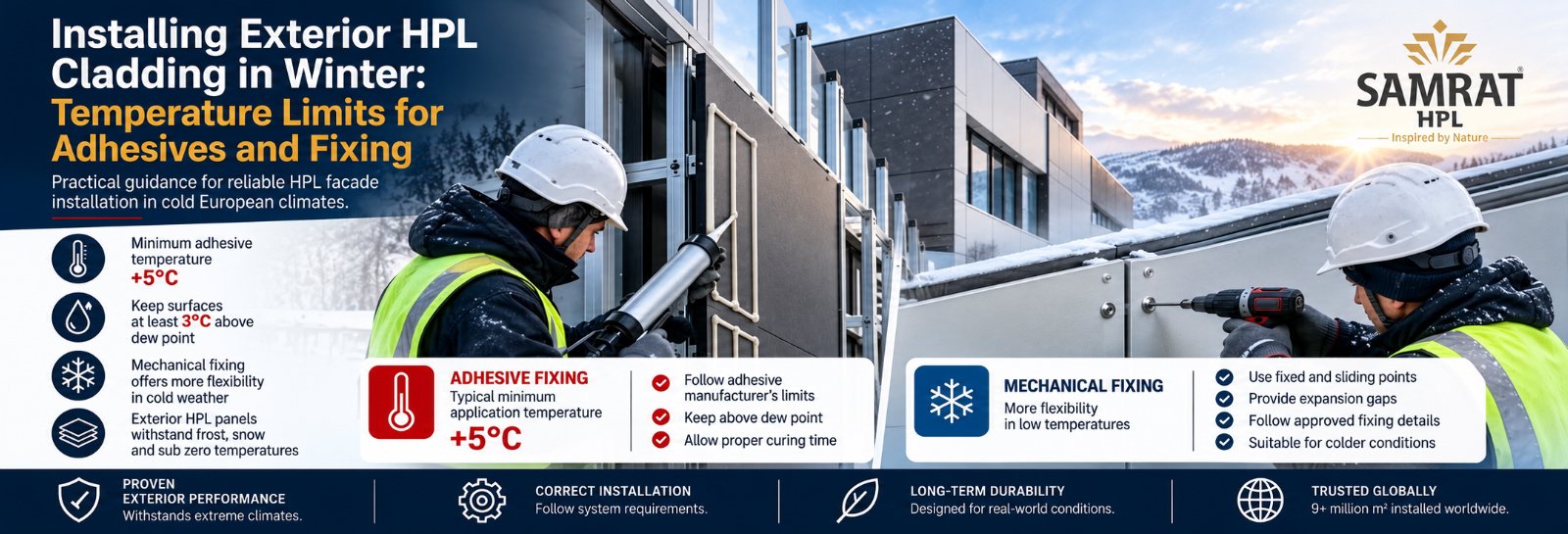
Installing Exterior HPL Cladding in Winter: Adhesive Temperature Limits & Mechanical Fixing
October 25, 2026 | Puneet Singhal
Can Exterior HPL cladding be installed during winter when temperatures fall to +5°C, 0°C or even below freezing?
Yes.
Exterior HPL installation in winter is possible, but the fixing method and site conditions determine whether installation can proceed safely.
For many commonly used façade adhesive systems, the minimum application temperature is +5°C, while bonding surfaces must remain sufficiently above the dew point to prevent condensation.
Mechanical fixing with rivets or screws generally offers greater flexibility in cold weather because it does not depend on adhesive curing.
Whether you are installing Trespa Meteon, Fundermax, Samrat Exterior HPL or another exterior-grade compact laminate, understanding the minimum adhesive application temperature, winter rivet fixing requirements and thermal expansion allowances is essential for reliable HPL façade installation in cold European climates.
The important distinction is simple:
Exterior HPL is engineered to withstand winter weather.
The challenge is installing the façade correctly in winter.
1. HPL Façade Adhesives: Understanding the +5°C Rule
Adhesive fixing is widely used for concealed Exterior HPL façade installations.
However, façade adhesives require specific environmental conditions to develop a reliable bond.
For example, SikaTack® Panel specifies an application temperature range of +5°C to +40°C, while its cured service-temperature range extends from approximately −40°C to +90°C.
This highlights an important difference:
An adhesive capable of surviving −40°C after curing cannot necessarily be applied at −40°C.
Low temperatures can affect adhesive application, curing speed, primer performance and bond development.
These are common requirements, not universal limits.
Always follow the current technical data sheets and approved installation instructions for the complete adhesive system.
| Condition | Typical Requirement |
|---|---|
| Ambient Temperature | Minimum +5°C for many systems |
| Panel and Substructure Temperature | Within the adhesive manufacturer’s approved range |
| Surface Temperature vs. Dew Point | At least 3°C above dew point where specified |
| Primer Application | Follow the primer’s individual temperature limits |
| Temperature After Bonding | Maintain conditions required during initial curing |
2. Condensation: The Hidden Risk During Winter Installation
One of the biggest problems during winter façade installation is condensation on bonding surfaces.
Imagine the outside temperature is +7°C.
The aluminium substructure may still be considerably colder, especially early in the morning.
If the metal surface temperature approaches the dew point, moisture can form on the surface.
Even a thin, almost invisible moisture layer can interfere with adhesive bonding.
This is why systems such as SikaTack Panel require bonding surfaces to remain at least 3°C above the dew point.
Before adhesive installation, contractors should check:
- Ambient temperature and relative humidity
- Actual panel and substructure temperatures
- Dew-point temperature
- Weather conditions during the required curing period
A dry-looking aluminium profile is not necessarily suitable for adhesive bonding.
A surface thermometer and reliable humidity measurement can help prevent expensive installation failures.
3. Mechanical Fixing of Exterior HPL in Winter
Mechanical fixing using rivets or screws can be a practical option when temperatures fall below the limits permitted for adhesive bonding.
Unlike adhesive systems, mechanical fasteners do not require chemical curing.
However, winter installation introduces another important consideration:
Thermal and moisture-related movement of the façade system.
Exterior HPL undergoes dimensional changes with moisture and temperature, while aluminium substructures expand and contract primarily with temperature.
A panel installed during winter must therefore have sufficient freedom to move as environmental conditions change.
The following principles are essential:
Fixed points: Use the fixed-point arrangement specified by the approved system, commonly one fixed point per panel.
Sliding points: Remaining fixing points must permit the required movement through correctly sized holes and suitable fastening details.
Centred fasteners: Rivets or screws must be positioned correctly within sliding holes.
Expansion gaps: Maintain the specified joint widths.
Never install panels tightly against each other.
Substructure movement: Follow approved details at rail expansion joints and avoid rigidly bridging movement joints.
Hole diameters, edge distances, fixing spacing and fastener specifications must always follow the panel manufacturer’s installation guide and relevant façade-system approval.
Related reading:
Fixed Point vs. Sliding Point in Exterior HPL
Expansion Gaps in Exterior HPL
4. Storage and Acclimatisation of HPL Panels in Winter
Correct storage is particularly important during cold-weather HPL installation.
Panels delivered from a warmer warehouse may initially have different temperature and moisture conditions from those at the installation site.
Sudden changes in conditions can influence panel dimensions and cause surface condensation.
Recommended practices include:
- Store panels horizontally on a flat, stable and adequately supported base.
- Keep panels dry, protected and off the ground.
- Protect panels from snow, standing water and condensation.
- Allow sufficient conditioning time before fabrication or installation.
- Do not cut, drill or bond panels while wet, icy or covered with condensation.
Some manufacturers recommend conditioning periods of approximately 48 hours, but this is not a universal requirement.
Follow the relevant manufacturer’s storage and acclimatisation instructions.
5. Adhesive vs. Mechanical Fixing in Winter
| Winter Condition | Adhesive Fixing | Mechanical Fixing |
|---|---|---|
| +15°C, dry | Generally suitable | Generally suitable |
| +5°C, dry | Possible with approved systems | Generally suitable |
| 0°C | Below the limits of many common adhesives | May be possible, depending on the system |
| Below 0°C | Usually outside standard bonding limits | System-dependent |
| Wet or icy surfaces | Do not proceed with bonding | Make site conditions safe before installation |
| Chemical curing | Required | Not required |
Actual installation suitability depends on the approved fixing system and site conditions.
6. Winter HPL Installation Checklist
Before starting façade installation, contractors should verify:
- Check the weather forecast, including overnight temperatures.
- Measure ambient and actual surface temperatures.
- Confirm dew-point requirements before adhesive bonding.
- Check adhesive, primer and curing temperature limits.
- Ensure panels are properly stored and conditioned.
- Confirm correct fixed and sliding points.
- Maintain specified expansion gaps and fixing-hole dimensions.
- Record installation conditions for quality and warranty documentation.
If adhesive bonding conditions cannot be maintained, postpone the work, use an approved controlled-environment installation arrangement, or consider a suitably designed mechanical fixing system.
7. Frequently Asked Questions
Can Exterior HPL cladding be installed below +5°C?
Yes, mechanical installation may be possible if the approved façade system and site conditions permit.
Many commonly used adhesive systems require application temperatures of at least +5°C.
What is the minimum installation temperature for Trespa, Fundermax or Samrat Exterior HPL?
The minimum installation temperature depends primarily on the approved fixing system, not simply the HPL brand.
Adhesive systems frequently specify a minimum application temperature of +5°C, while mechanically fixed panels may be installed at lower temperatures when the manufacturer’s instructions and site conditions permit.
Always check the applicable panel installation guide and adhesive or fastener specifications.
Can HPL façade panels be riveted or screwed in freezing temperatures?
Mechanical fixing may be possible in freezing conditions because rivets and screws do not require adhesive curing.
However, installers must follow approved fixing details, allow for panel movement and avoid unsafe, icy or otherwise unsuitable working conditions.
Does freezing weather damage Exterior HPL panels?
Exterior-grade HPL is engineered for outdoor exposure, including freezing conditions.
However, performance depends on the product grade, installation design and correct fixing.
What is the dew-point rule for HPL adhesive fixing?
For systems requiring a 3°C margin, bonding surfaces must remain at least 3°C warmer than the dew-point temperature to reduce the risk of condensation.
How long should HPL panels acclimatise before winter installation?
Some manufacturers recommend approximately 48 hours, but the correct conditioning period depends on the product, storage conditions and installation instructions.
Is mechanical fixing better than adhesive fixing in winter?
Mechanical fixing generally offers more flexibility in cold weather because no adhesive curing is required.
However, the fixing system must be correctly designed to accommodate panel movement.
Conclusion: Winter Installation Is Possible with the Right Precautions
Winter does not have to stop an Exterior HPL façade project.
The key is choosing the appropriate fixing system and understanding its installation requirements.
For adhesive fixing, temperature, condensation and curing conditions are critical.
For mechanical fixing, correct fastener installation, expansion allowances and panel movement are essential.
A façade installed in January must be capable of performing reliably when summer temperatures arrive.
That is why correct installation matters just as much as the quality of the Exterior HPL itself.
Samrat Exterior HPL — Engineered for Long-Term Façade Performance
With more than 18 years of dedicated Exterior HPL manufacturing experience and over 9 million m² installed worldwide, Samrat Exterior HPL focuses on durable façade solutions for different climatic conditions.
For technical specifications, installation guidance and recommended fixing practices, contact the Samrat HPL technical team.
Samrat Exterior HPL — Built for a Brighter Tomorrow.