


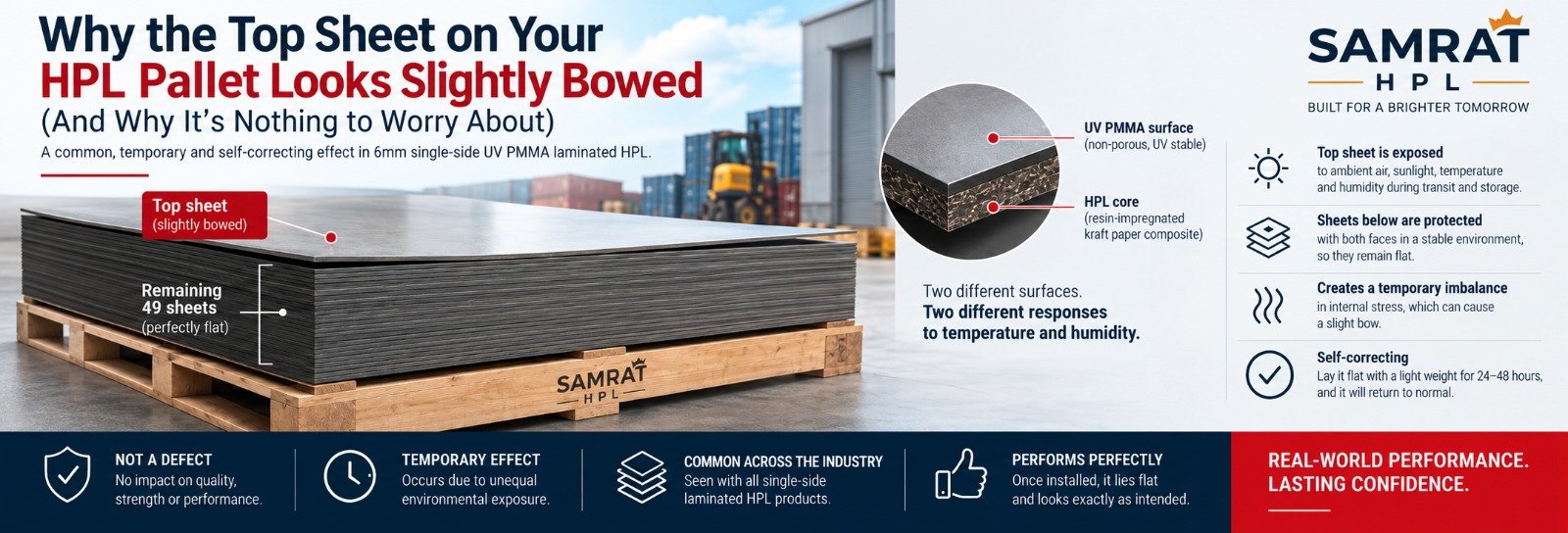
Why the Top Sheet on Your HPL Pallet Looks Slightly Bowed — And Why It’s Nothing to Worry About
Understanding Temporary Bowing in 6 mm Single-Side UV PMMA Exterior HPL Panels
You unwrap a pallet of 6 mm Exterior HPL panels after a long shipment.
Almost every sheet in the stack is perfectly flat.
But the very top sheet has a slight curve or bow.
The first reaction is understandable:
“Is this panel warped?”
Or perhaps:
“Is there something wrong with the HPL?”
In the case of single-side UV PMMA laminated Exterior HPL, a slight bow on the top sheet can occur because that panel has been exposed differently from all the sheets underneath it.
It is typically a temporary conditioning effect caused by unequal environmental exposure across the two faces of the panel, rather than damage to the HPL core or failure of the UV surface.
Understanding why this happens makes the phenomenon much easier to evaluate—and, importantly, much easier to correct.
Two Different Surfaces on One Exterior HPL Panel
A single-side UV PMMA Exterior HPL panel is intentionally asymmetric.
One face carries the decorative exterior surface together with the UV-protective PMMA layer.
The opposite face is the reverse side of the Compact HPL core.
These two faces are therefore not identical.
The Exterior HPL itself consists of compressed kraft papers impregnated with thermosetting phenolic resin and consolidated under high pressure and temperature.
The UV-facing side additionally carries the protective exterior surface system.
This means the two sides can react slightly differently when exposed to changes in:
- Temperature
- Relative humidity
- Air circulation
- Solar heat
- Storage conditions
Under normal balanced conditions, this difference is not noticeable.
The panel remains flat.
The situation becomes more interesting when one face experiences a different environment from the other.
Why Does Only the Top HPL Sheet Bow?
The important factor is not simply the panel.
It is exposure.
Imagine a pallet containing 50 sheets of Exterior HPL.
Sheets in the middle of the stack are tightly sandwiched between neighbouring sheets.
Their upper and lower surfaces therefore experience very similar conditions.
They are protected from:
- Direct sunlight
- Rapid temperature changes
- Strong air circulation
- Sudden humidity changes
Effectively, the stack creates its own relatively stable microenvironment.
Both faces of these sheets respond almost equally.
So they remain flat.
The top sheet is different.
Its lower face remains protected by the sheet immediately beneath it.
But its upper face is exposed directly to the surrounding environment.
During long-distance transportation or warehouse storage, that exposed surface may experience:
- Ambient air
- Temperature fluctuations
- Changing humidity
- Container heating and cooling
- Sunlight or radiant heat
- Different moisture exchange
One face therefore responds faster than the other.
And that temporary imbalance can create a slight curvature across the panel.
What Is Actually Happening Inside the Panel?
A simple way to understand it is to imagine two surfaces trying to respond differently at the same time.
If one face expands or contracts slightly faster than the other, a small internal stress develops through the thickness of the panel.
Instead of remaining perfectly flat, the sheet can temporarily curve.
This is the same basic engineering principle seen in many layered materials.
Importantly, this does not automatically mean that the core has failed, the PMMA has separated, or the board has lost its mechanical integrity.
The panel is responding to an environmental imbalance.
Once that imbalance is removed, the stresses can progressively equalise again.
Why Is the Effect More Noticeable After Sea Freight?
Exterior HPL exported internationally can remain inside a shipping container for many weeks.
During that journey, environmental conditions can change considerably.
A container may move through:
- Hot ports
- Cooler ocean conditions
- High-humidity environments
- Dry environments
- Strong day/night temperature cycles
The top sheet is naturally the most exposed production sheet in the stack.
The sheets underneath are comparatively insulated by the pallet itself.
This is why a customer may sometimes open a pallet after a long journey and see:
One slightly bowed top sheet — while the remaining stack is completely flat.
That pattern is important.
If nearly the whole pallet remains flat and the effect is concentrated at the exposed top sheet, environmental conditioning should be considered before concluding that there is a structural manufacturing problem.
Is This HPL Warping?
It is more useful to describe this particular phenomenon as temporary bowing rather than permanent warping.
There is an important difference.
Temporary Bowing
May result from:
- Unequal environmental exposure
- Temperature differences
- Humidity differences
- Storage or transport conditions
and can reduce after the panel is returned to balanced conditions.
Permanent Distortion
May require further investigation and could be associated with:
- Severe or prolonged incorrect storage
- Mechanical deformation
- Unsupported stacking
- Abnormal manufacturing conditions
- Other material or installation issues
So a slightly curved top sheet should not immediately be classified as permanently warped.
Why Single-Side UV PMMA HPL Can Show This Effect
The key phrase is single-side.
With a double-sided symmetrical construction, both faces of a panel are more similar.
With a single-side Exterior HPL construction, one side carries the exterior decorative and UV-protective system while the reverse has a different surface structure.
That asymmetry is intentional.
It allows the panel to provide the required decorative exterior performance without unnecessarily applying the same exterior surface system to the reverse side.
But because the surfaces differ, balanced storage and environmental conditioning become particularly important.
This does not mean that PMMA itself is defective or causes HPL to warp.
Rather, the single-side construction means that uneven environmental exposure can become more visible on the first exposed sheet.
Is the Bow a Manufacturing Defect?
In the situation described above, generally no.
A manufacturing defect normally implies that something in the structure of the panel has permanently failed or has been produced outside acceptable requirements.
A temporary top-sheet bow caused by unequal conditioning is fundamentally different.
The panel can still have:
- A sound Compact HPL core
- Correct internal bonding
- Proper PMMA adhesion
- Normal mechanical strength
- Correct surface appearance
- Normal long-term performance
The fact that the sheets immediately underneath remain flat is also useful evidence when evaluating the situation.
How Do You Flatten the Top HPL Sheet?
The corrective procedure is very simple.
Step 1 — Remove the sheet from the pallet
Place the affected panel onto a completely flat and fully supported surface.
Step 2 — Allow the panel to acclimatise
Keep the panel under stable indoor ambient conditions.
This gives both surfaces an opportunity to move toward the same environmental equilibrium.
Step 3 — Apply light, evenly distributed restraint
Place another flat panel, board, or similar evenly distributed light load over it.
Avoid point loads.
The aim is simply to keep the sheet evenly supported while it reconditions.
Step 4 — Allow sufficient time
A practical conditioning period is typically around 24–48 hours, although the actual time can vary depending on temperature, humidity, previous transport conditions and the amount of bow.
In most mild top-sheet cases, the curvature reduces substantially as the panel re-equalises.
Why Does Re-Flattening Work?
Remember why the bow appeared in the first place:
one face experienced different conditions from the other.
Once the panel is removed from that asymmetric stack condition and stored flat in a stable environment, the difference between the two surfaces begins to reduce.
As equilibrium returns, the internal stresses responsible for the temporary curvature also reduce.
So the panel moves back toward its normal flat condition.
Does This Affect the Final Façade Installation?
A minor temporary top-sheet bow should not automatically affect the final application.
Once appropriately conditioned, the panel is installed onto an engineered façade support system using:
- Rivets or mechanical fasteners
- Adhesive fixing systems
- Aluminium profiles
- Correct fixing centres
- Expansion gaps
- Fixed and sliding points
The panel is then supported at multiple locations.
For this reason, a temporary condition observed immediately after unpacking should not be confused with the final installed geometry of the façade.
Of course, panels should always be conditioned properly before fabrication and installation.
Related Technical Guides
Read More → Fixed Point & Sliding Point in Exterior HPL
Read More → Expansion Gaps in Exterior HPL
Read More → Exterior HPL Installation Guide
Does Temporary Bowing Affect PMMA Adhesion?
No—temporary curvature of the panel should not be confused with delamination.
Delamination means separation between layers.
Temporary bowing caused by differential conditioning is a dimensional response of the overall sheet.
The two are completely different phenomena.
If the PMMA remains properly bonded to the decorative surface and there is no physical separation, blistering or loss of adhesion, a slight temporary panel curvature does not in itself indicate PMMA failure.
Read More → Why Exterior HPL Does Not Delaminate
Read More → PMMA Protection in Exterior HPL
Why the Remaining Sheets Stay Flat
This is one of the easiest ways to understand the phenomenon.
If manufacturing itself were fundamentally responsible for the bowing, one might expect multiple panels throughout the pallet to behave similarly.
Instead, what is often observed is:
Top sheet → slightly bowed
Sheet 2 → flat
Sheet 3 → flat
Sheet 4 → flat
Remaining stack → flat
What changed?
Not the manufacturing process.
Not the HPL composition.
Not the production batch.
The major difference was environmental exposure.
The top panel had one exposed face.
The others did not.
How Samrat HPL Minimises Top-Sheet Exposure
Because we understand this behaviour, packaging becomes an important part of the solution.
For single-side UV PMMA Exterior HPL, Samrat uses an additional dummy HPL sheet above the first saleable production panel.
This dummy sheet acts as a protective cover.
Instead of the customer’s first Exterior HPL panel being directly exposed to transport and storage conditions, the dummy panel receives the greatest environmental exposure.
This helps the actual production panels underneath remain under more balanced conditions during transportation.
It is a simple packaging measure, but particularly valuable for long-distance sea freight.
Simple Handling Practices That Help
Although temporary top-sheet bowing is manageable, correct handling can reduce the possibility considerably.
Keep HPL pallets flat and fully supported.
Keep the pallet covered until required.
Avoid exposing a partially opened pallet to direct sunlight or extreme temperature changes for long periods.
Store Exterior HPL in a dry, protected environment.
After long-distance transport, allow panels time to acclimatise before cutting or installation.
If the pallet will remain partially used for an extended period, place a flat protective sheet over the remaining stack.
These are good HPL handling practices regardless of manufacturer.
Frequently Asked Questions
Why is only the top Exterior HPL panel bowed?
Because the top sheet is the only production panel whose two faces can experience significantly different environmental conditions. One face is exposed to the surroundings while the other remains protected by the stack.
Does this mean the Exterior HPL is defective?
Not necessarily. A slight temporary bow concentrated on the exposed top sheet can be caused by unequal environmental conditioning rather than a structural defect.
Will the panel become flat again?
Minor temporary bowing will often reduce significantly after the sheet is laid flat, fully supported and allowed to acclimatise under balanced ambient conditions.
How long should the HPL panel be conditioned?
A practical starting period is approximately 24–48 hours, though more time may be necessary depending on environmental conditions and the degree of curvature.
Can I put weight on the panel?
Yes, but use a flat board or panel providing evenly distributed restraint. Avoid concentrated point loads that could mark or damage the surface.
Does the PMMA film cause the bow?
It is more accurate to say that single-side construction creates an asymmetric panel surface system. When those different surfaces experience unequal environmental exposure, temporary curvature can become more noticeable.
Why don’t the sheets underneath bow?
Because both their faces are protected by adjacent sheets and experience essentially the same microenvironment inside the stack.
Will this affect the panel after façade installation?
A mildly bowed panel that has been properly acclimatised and returned to acceptable flatness before installation should perform normally when installed onto a correctly engineered support system.
Is this delamination?
No. Bowing and delamination are different phenomena. Delamination involves physical separation between layers. Temporary bowing is curvature of the overall panel.
The Bottom Line
A slight bow on the top sheet of a 6 mm single-side UV PMMA Exterior HPL pallet can look worrying when the pallet is first opened.
But look at the complete picture.
The panels underneath are flat.
There is no separation of layers.
There is no failure of the PMMA surface.
There is no visible damage to the HPL core.
The major difference is simply that the top sheet has spent weeks with one face exposed and the other face protected.
That unequal exposure can temporarily create different dimensional responses between the two surfaces—and therefore a slight bow.
Return the sheet to a flat, fully supported, balanced environment, allow it to acclimatise, and use light evenly distributed restraint where appropriate.
The important lesson is simple:
Temporary top-sheet bowing caused by asymmetric environmental exposure should not automatically be mistaken for defective Exterior HPL.
At Samrat Exterior HPL, understanding these real-world behaviours is part of our approach to façade engineering—from panel manufacturing and PMMA protection to packing, transportation, handling and final installation.